Canada Express Entry for Allied Health Professionals: Complete 2026 Guide
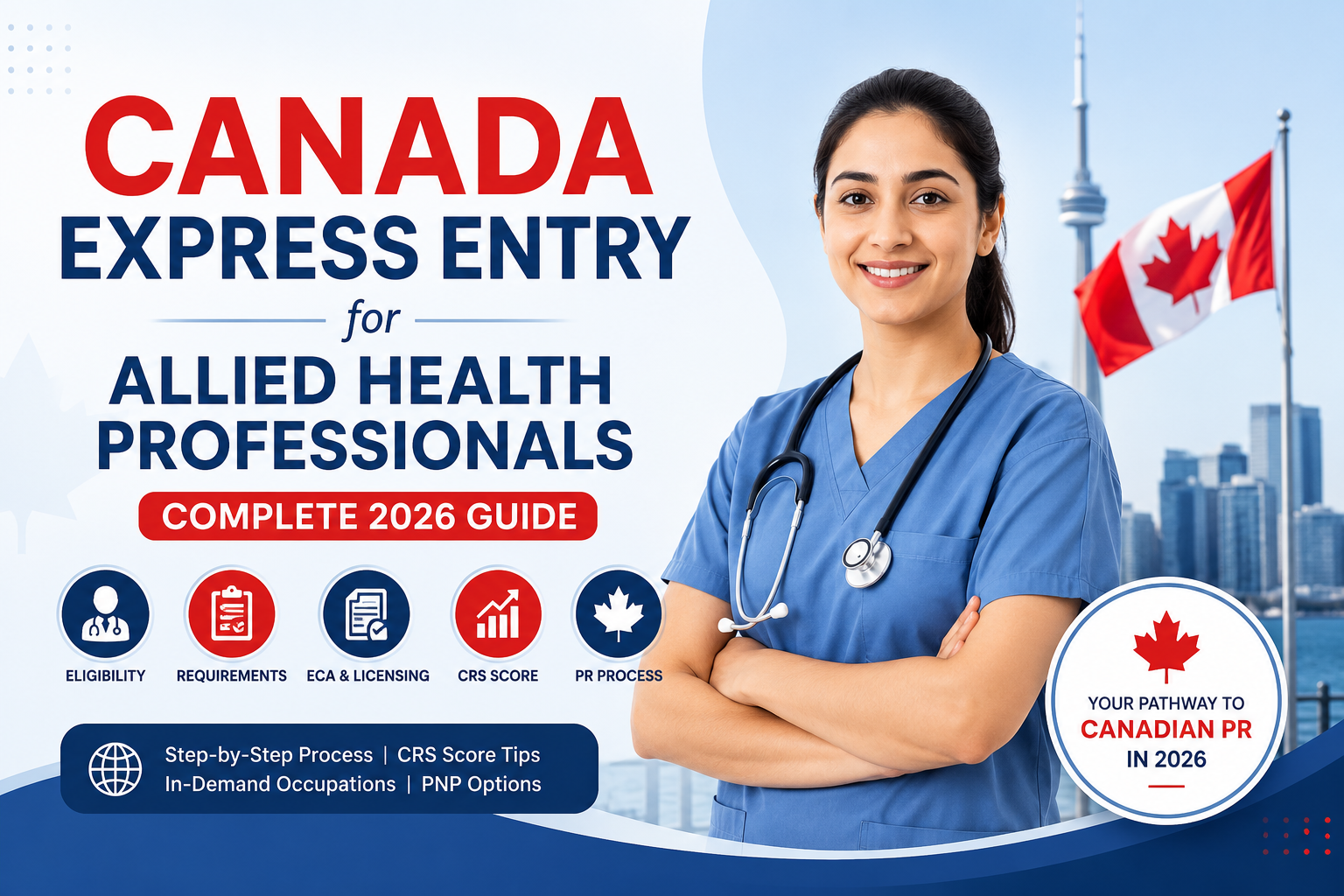
The Canada Express Entry allied health professionals pathway is more accessible than most Pakistani applicants realize. Most Pakistani allied health professionals assume Canadian immigration is a doctors-and-nurses game, and that assumption is costing them a genuinely faster route to permanent residence. Canada’s Express Entry system now runs a dedicated healthcare category that covers more than 35 occupations — physiotherapists, medical laboratory technologists, radiographers, respiratory therapists, and dental hygienists among them — with invitation cutoffs that have consistently sat well below the general draws. If you’ve written this off as a doctor/nurse-only pathway, it’s worth a second look.
Quick answer: Canada’s Express Entry healthcare category-based selection covers 37+ NOC codes including physiotherapists, medical lab technologists, radiation technologists, and respiratory therapists. You need qualifying work experience (check current minimum on IRCC‘s site — it has changed between 6 and 12 months across recent rounds), a valid Express Entry profile through FSW/CEC/FST, and a CRS score that clears the healthcare-specific cutoff — historically 40-80 points lower than general draws.
Canada Express Entry Allied Health Professionals: Why This Category Matters
Canada restructured Express Entry a few years ago to let it invite candidates by category rather than purely by overall CRS rank — and healthcare was one of the first categories created, precisely because the general points system was locking out professionals the country desperately needs. The results show it: 2025 healthcare draws ranged from a CRS cutoff of 431 up to 476, and by early 2026 the floor had stabilized in the 440–460 range for larger rounds. Compare that to Canadian Experience Class draws clearing north of 500, and the gap becomes the whole point of this category — it exists to let qualified healthcare workers in without needing a near-perfect CRS profile.
The list of eligible occupations is broader than most people expect. It spans physicians, dentists, optometrists, pharmacists, nurses, psychologists, audiologists, physiotherapists, occupational therapists, paramedics, dental hygienists, kinesiologists, and a cluster of allied roles — including respiratory therapists and cardiopulmonary technologists, medical laboratory technologists, and diagnostic medical sonographers and technologists.
Which Allied Health NOC Codes Actually Qualify
Your eligibility comes down to one thing: does your primary occupation match a code on IRCC’s published healthcare list. Based on current published lists, the allied health-relevant codes include:
- NOC 31202 — Physiotherapists
- NOC 32120 — Medical laboratory technologists
- NOC 32121 — Medical radiation technologists
- NOC 32122–32124 — Diagnostic medical sonographers and related technologists
- NOC 32103 — Respiratory therapists and cardiopulmonary technologists
- NOC 32102 — Paramedical occupations
- NOC 32111 — Dental hygienists and dental therapists
- NOC 32109 — Other technical occupations in therapy and assessment
- NOC 32101 — Licensed practical nurses
One critical detail: it’s your primary NOC that must match — the occupation tied to your most recent or highest-points work experience. A secondary job history in a matching occupation doesn’t unlock category eligibility if your primary listed experience is something else. Get your NOC classification right before you build your profile around it.
The Eligibility Requirements
1. Qualifying work experience. You need continuous full-time work (or the part-time equivalent) in an eligible NOC within the past three years. Here’s an important caveat: the minimum duration has shifted across recent rounds — some healthcare draws have required 6 months, while renewed categories in 2026 raised the bar to 12 months. Because this changes between draws, verify the current requirement directly on Canada.ca before assuming either number applies to you.
2. International experience counts. This is the detail Pakistani professionals most often miss: your work experience doesn’t need to be Canadian. Time spent working as a physiotherapist, MLT, or radiographer in Pakistan (or anywhere else) toward your qualifying period counts the same as Canadian experience for category eligibility.
3. Base Express Entry eligibility. The healthcare category doesn’t replace the underlying programs — you still need to qualify for Federal Skilled Worker, Canadian Experience Class, or Federal Skilled Trades first, which means meeting language requirements (generally CLB 7 for FSW), having your credentials assessed (ECA), and building a complete Express Entry profile.
4. A CRS score that clears the healthcare cutoff. Once you’re in the pool, IRCC issues Invitations to Apply (ITAs) to candidates in the healthcare category above a threshold that resets with each draw. This cutoff moves constantly, so treat any specific number as a snapshot, not a guarantee — check IRCC’s official draw results for the current figure before assuming where you stand.
Provincial Nominee Programs: A Parallel, Often Faster Route
Federal Express Entry isn’t the only door. A provincial nomination adds 600 CRS points, making an Invitation to Apply virtually certain in any subsequent draw, and several provinces run healthcare-specific streams with more accessible bars than the federal cutoff.
The Saskatchewan Immigrant Nominee Program includes healthcare occupations under its Express Entry and Occupation In-Demand categories, actively recruiting registered nurses, licensed practical nurses, and medical laboratory technologists. Ontario launched a Workforce Priority Stream in mid-2026 targeting healthcare occupations among others, reviewed on a rolling basis. Alberta also runs active healthcare-focused streams. If your NOC code appears on a province’s in-demand list, a provincial nomination is frequently the more realistic path — it sidesteps the federal cutoff entirely.
Regulated vs. Non-Regulated: What Happens After You Land
Here’s a distinction that matters more than most immigration guides mention: qualifying for Express Entry through a healthcare NOC code is an occupation-matching exercise, not a licensing exercise. IRCC’s category list doesn’t check whether your profession is regulated in Canada — it just confirms your NOC matches.
Once you land, though, provincial regulation takes over. Physiotherapists, for example, are provincially regulated across Canada, meaning you’ll need to register with the relevant provincial college (such as the College of Physiotherapists of Ontario or the equivalent body in your destination province) before you can practice — a separate process from your immigration application, with its own credential assessment and, in many cases, a licensing exam. Medical laboratory technologists face similar provincial regulatory requirements in most provinces. Start researching your specific province’s licensing body well before you land, not after.
This mirrors how Gulf countries structure allied health licensing — the UAE, for instance, requires separate registration through DHA, DOH, or MOHAP depending on which emirate you will work in, entirely separate from any visa or immigration process.
Common Mistakes Pakistani Applicants Make
Assuming this category is only for doctors and nurses. It isn’t — but the myth persists, and qualified physiotherapists and MLTs skip building an Express Entry profile because they never checked the actual NOC list.
Misclassifying their primary NOC. If your job title doesn’t map cleanly to a single NOC code, get a professional NOC assessment rather than guessing — an incorrect primary NOC can disqualify an otherwise strong profile.
Ignoring provincial programs. Chasing only the federal healthcare draw while ignoring Saskatchewan, Ontario, or Alberta’s dedicated streams means missing a route that’s frequently faster and less competitive.
Not researching provincial licensing before landing. Immigration and professional licensing are two separate systems. Landing as a permanent resident doesn’t automatically authorize you to practice — plan your provincial registration process in parallel with your immigration timeline, not after arrival.
Treating a single CRS cutoff as permanent. Cutoffs move every draw based on pool size and composition. A score that misses one round can clear the next.
Frequently Asked Questions
No. International work experience in an eligible NOC counts the same as Canadian experience for category eligibility — you don’t need to have worked in Canada first.
No. Physiotherapy is provincially regulated, so you’ll need your credentials assessed and registered with the relevant provincial regulatory college before practicing, separate from your immigration application.
This has varied between 6 and 12 months across recent draws and renewed categories. Always confirm the current requirement on Canada.ca before building your application around a specific number.
Not universally better, but often more accessible — a provincial nomination adds 600 CRS points, effectively guaranteeing an invitation. If your NOC appears on a province’s in-demand list, it’s worth pursuing both routes simultaneously.
You can still pursue general Express Entry through FSW, CEC, or FST if you meet those programs’ requirements — you’d simply compete under general draws rather than the healthcare category’s lower cutoffs.
Where to Start Your Canada Express Entry Allied Health Professionals Application
Confirm your exact NOC code, check the current work-experience minimum on Canada.ca, and build your Express Entry profile around accurate information rather than a number you saw on a blog. Then research both the federal healthcare category and your target province’s nominee program in parallel — for many allied health professionals, the provincial route ends up being the faster one. Whichever path you choose, understanding the Canada Express Entry allied health professionals process thoroughly before you apply saves months of avoidable delay.
Planning your international career move, whether to Canada, the Gulf, or elsewhere? Allied Health Organization Pakistan membership includes an official organizational reference letter, AHPC registration guidance, and access to our CPD programs. Apply for AHO Membership