DHA, DOH & MOHAP License Guide for Pakistani Allied Health Professionals (2026): Which UAE License Do You Actually Need?
Most candidates start their UAE job search by googling “UAE healthcare license requirements,” and that phrase itself is the first mistake. There is no single UAE license. Three separate authorities regulate Dubai, Abu Dhabi, and the Northern Emirates, each with its own portal, its own exam, and its own rules — and a license from one does not automatically let you work in another. If you’re a physiotherapist, radiographer, respiratory therapist, medical lab technologist, or any other allied health professional from Pakistan planning a UAE move, understanding this distinction before you start paperwork will save you months. This DHA DOH MOHAP license guide breaks down exactly which authority governs your target emirate, and the full process to get licensed in 2026.
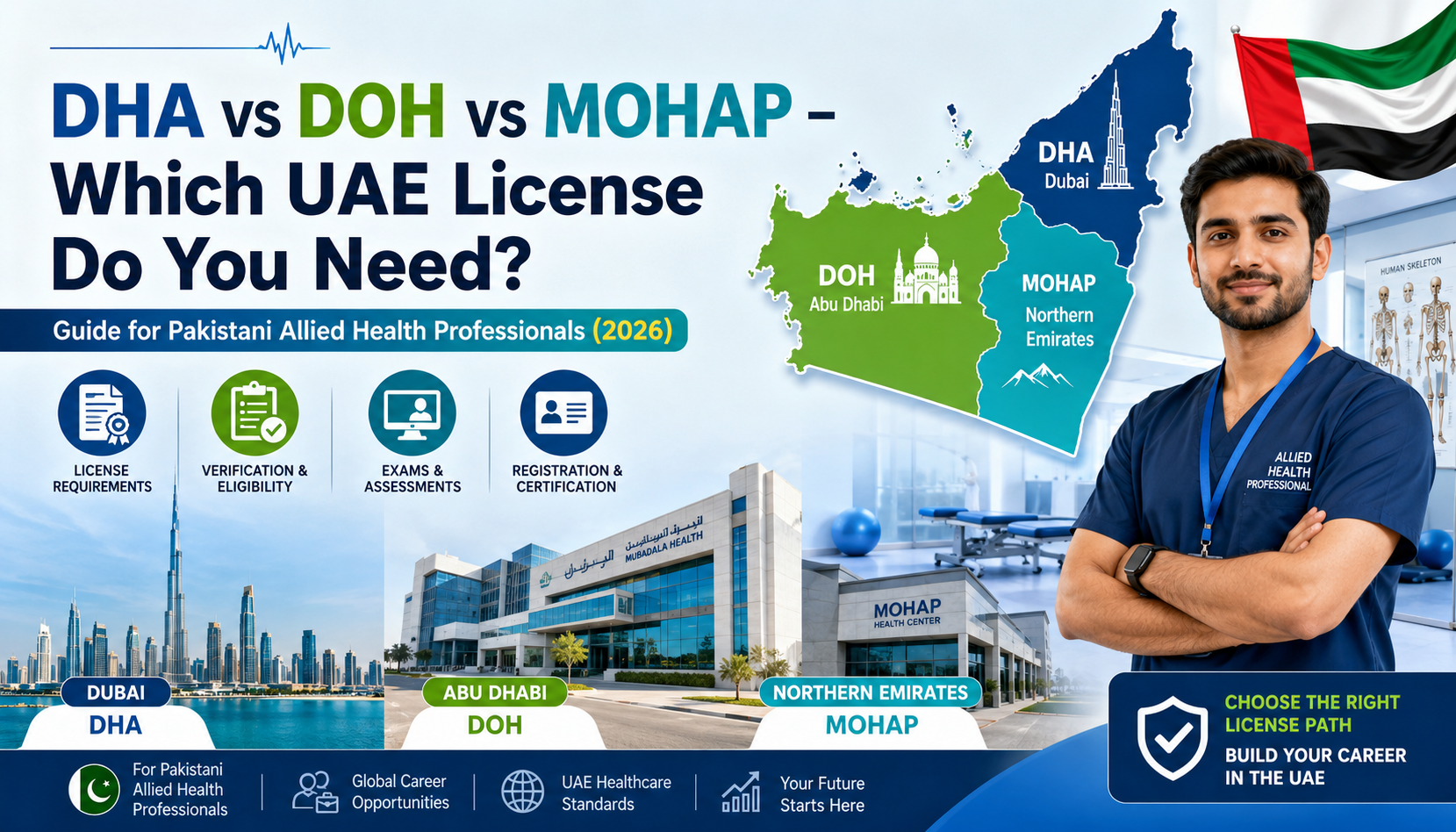
Quick answer: You need a DHA license only if your employer is in Dubai, a DOH license (formerly HAAD) for Abu Dhabi or Al Ain, or a MOHAP license for the Northern Emirates. These licenses don’t transfer between emirates — confirm your employer’s city first, then follow that authority’s process.
The Three Authorities, and Why It Matters Which One You Target
DHA — Dubai Health Authority. Governs licensing for every healthcare facility physically located in Dubai. If your job offer is from a Dubai hospital, clinic, or diagnostic center, this is your authority.
DOH — Department of Health Abu Dhabi (formerly HAAD). Governs Abu Dhabi and Al Ain. The name change from HAAD to DOH happened years ago, but the process, exams, and portal are still commonly searched under the old name — they’re the same system. If your offer is from an Abu Dhabi facility, this is your authority, and applications now run through the Sheryan portal.
MOHAP — Ministry of Health and Prevention. Governs the Northern Emirates: Sharjah, Ajman, Fujairah, Ras Al Khaimah, and Umm Al Quwain.
Here’s the part that catches people off guard: these licenses generally do not transfer automatically between emirates. A DHA license lets you practice in Dubai facilities. It does not let you walk into an Abu Dhabi hospital and start working the next day. Professionals who build a career across emirates typically convert or add licenses as they move employers, which is an additional process, not a formality. Decide which emirate your target employer is actually in before you start anything — it determines the entire pathway.
Use this table as a quick reference for your DHA DOH MOHAP license decision:
\n| Authority | Emirates Covered | Formerly Known As | Portal |
|---|---|---|---|
| DHA | Dubai | — | DHA online licensing portal |
| DOH | Abu Dhabi, Al Ain | HAAD | Sheryan |
| MOHAP | Sharjah, Ajman, Fujairah, Ras Al Khaimah, Umm Al Quwain | — | MOHAP licensing portal |
The Universal Process (All Three Authorities Follow This Shape)
Despite being separate authorities, DHA, DOH, and MOHAP all run applicants through the same basic sequence. The names of the portals differ, but the logic doesn’t.
Steps 1–4: Qualification, Verification, and Standing
Step 1 — Confirm your Professional Qualification Requirement (PQR). Each authority publishes a PQR document specific to your profession — physiotherapist, radiographer, lab technologist, respiratory therapist, and so on. This tells you the minimum degree level and post-qualification clinical experience you need. Experience thresholds are typically higher for specialist-level classification than for general practice categories, and authorities revise them periodically, so check the current PQR on the authority’s own site rather than relying on a consultant’s summary from last year.
Step 2 — Complete DataFlow Primary Source Verification (PSV). This is non-negotiable and identical in spirit across all three authorities: DataFlow independently verifies your degree, transcripts, and experience letters directly with the issuing universities and employers. This step is consistently the longest part of the process — expect it to take several weeks, longer if any of your documents have inconsistencies the verifying institution needs to clarify.
Step 3 — Secure a Good Standing Certificate. Most categories require a certificate confirming you’re in good professional standing. Your most recent registering authority issues this certificate — in Pakistan, that’s your AHPC registration — and it typically needs a date within six months of your application. Request this only once you’re close to submitting, since an expired Good Standing Certificate means requesting a new one.
Step 4 — Meet English proficiency requirements where applicable. Depending on your profession and prior training background, you may need to submit an English proficiency certificate alongside your application.
Steps 5–7: Exam, Eligibility, and License Activation
Step 5 — Sit the licensing exam, where your category requires one. All three authorities test through Prometric. Passing scores are typically in the 50–65% range depending on the authority and profession, but treat any number you read online — including this one — as indicative only, and confirm the current threshold on the exam booking page before you schedule. Most authorities cap you at three exam attempts before additional requirements kick in, so prepare properly rather than treating the first attempt as a practice run.
Step 6 — Receive your Eligibility Letter. Passing the exam (or being exempted from one, in a small number of categories) gets you an eligibility letter. This is not a working license yet — it’s what you use to apply for jobs.
Step 7 — Employer-sponsored license activation. Once you have a signed offer, your employer submits the final activation request on your behalf. Only after this step can you legally begin work. This step also usually ties your license to your Emirates ID and residency process.
Total timeline across all three authorities typically runs two to four months, from the start of DataFlow verification to holding your eligibility letter. This assumes clean documentation throughout. Document issues — mismatched name spellings, missing experience letters, unclear transcripts — are the single biggest cause of delay. They’re entirely within your control to prevent before you submit anything.
Where Allied Health Professions Diverge From Each Other
The framework above is universal, but the details shift by profession, and this is where candidates commonly misjudge their own timeline.
Experience thresholds scale with classification level, not with profession alone. A general-category applicant in any allied health discipline typically needs less post-qualification experience than someone applying for a specialist or consultant-level classification in the same field. If your qualification and experience genuinely support a higher classification, apply for it — the salary and scope-of-practice difference over a career is significant, and downgrading later to fix an application is far more painful than getting it right the first time.
Exam content is profession-specific, not generic “healthcare knowledge.” A physiotherapist’s Prometric exam tests physiotherapy-specific clinical scenarios; a radiographer’s tests imaging-specific content. Online vendors frequently sell generic “healthcare exam” question banks that don’t match your actual profession — verify you’re studying the correct exam code for your specific category before buying any prep material.
Some categories carry additional requirements — certain specialist and consultant classifications may require structured interviews or practical assessments on top of the written exam. Don’t assume your profession follows the simplest pathway without checking your specific PQR document.
Why Pakistani Candidates Should Finalize AHPC Registration First
This is worth repeating because it’s the most common, most avoidable delay we see: your AHPC registration in Pakistan is frequently the document that both DataFlow and your Good Standing Certificate request will need. Professionals who start their UAE paperwork before finishing AHPC registration routinely end up waiting on both processes simultaneously, which compounds delays rather than running them in parallel efficiently. Complete your domestic registration first. Everything downstream moves faster once that foundation is in place.
The Mistakes That Cost Candidates the Most Time
Targeting the wrong authority for the job. Applying for a DHA license when your actual job offer is in Abu Dhabi wastes weeks. Confirm the facility’s emirate before you touch any paperwork.
Underestimating the DataFlow timeline. Candidates who assume DataFlow takes “a couple of weeks” and plan a job start date around that assumption are consistently the ones who end up requesting employers to push back start dates. Build in buffer time.
Applying below your actual classification. As covered above, this locks in a lower ceiling that’s harder to fix retroactively than to get right at application time.
Letting the Good Standing Certificate expire before submission. Since it’s typically only valid for six months from issuance, request it late in your process, not early.
Skipping AHPC registration to “save time.” It doesn’t save time — it just moves the delay to a later, more expensive point in the process.
Frequently Asked Questions
No. DHA, DOH, and MOHAP are separate regulatory authorities for Dubai, Abu Dhabi/Al Ain, and the Northern Emirates respectively. A license from one does not automatically authorize practice under another; moving between them typically requires an additional conversion or fresh application process.
Budget two to four months from the start of DataFlow verification to receiving your eligibility letter, assuming your documents are clean and complete. Incomplete or inconsistent documentation is the most common cause of delays beyond this range.
Most do, through Prometric, but a small number of categories may qualify for exemptions based on specific qualifications or licensing background. Check your specific profession’s PQR document rather than assuming either way.
The Eligibility Letter confirms you’ve passed the required verification and exam steps and can now apply for jobs. Your employer only issues the full practicing license after they sponsor and activate it on your behalf — you cannot legally practice on an eligibility letter alone.
Yes. Your Good Standing Certificate and DataFlow verification frequently require it as supporting documentation. Finalizing it before starting your UAE application removes one of the most common bottlenecks in the entire process.
Getting Started With Your DHA DOH MOHAP License
Every DHA DOH MOHAP license application follows the same three-step foundation. Before you spend money on exam prep or a consultant, do three things: confirm which emirate your target employer is actually in, pull your profession’s specific PQR document from the relevant authority’s own site, and make sure your AHPC registration is fully finalized. Those three steps, done in that order, are what separate a two-month licensing process from a six-month one.
If your AHPC registration isn’t finalized yet, that’s the place to start — it’s the document every downstream verification step will eventually ask for. Get these fundamentals right, and your DHA DOH MOHAP license application moves from a six-month guessing game to a two-month formality.