Medical Coding vs Medical Billing: Career Options for Allied Health Graduates
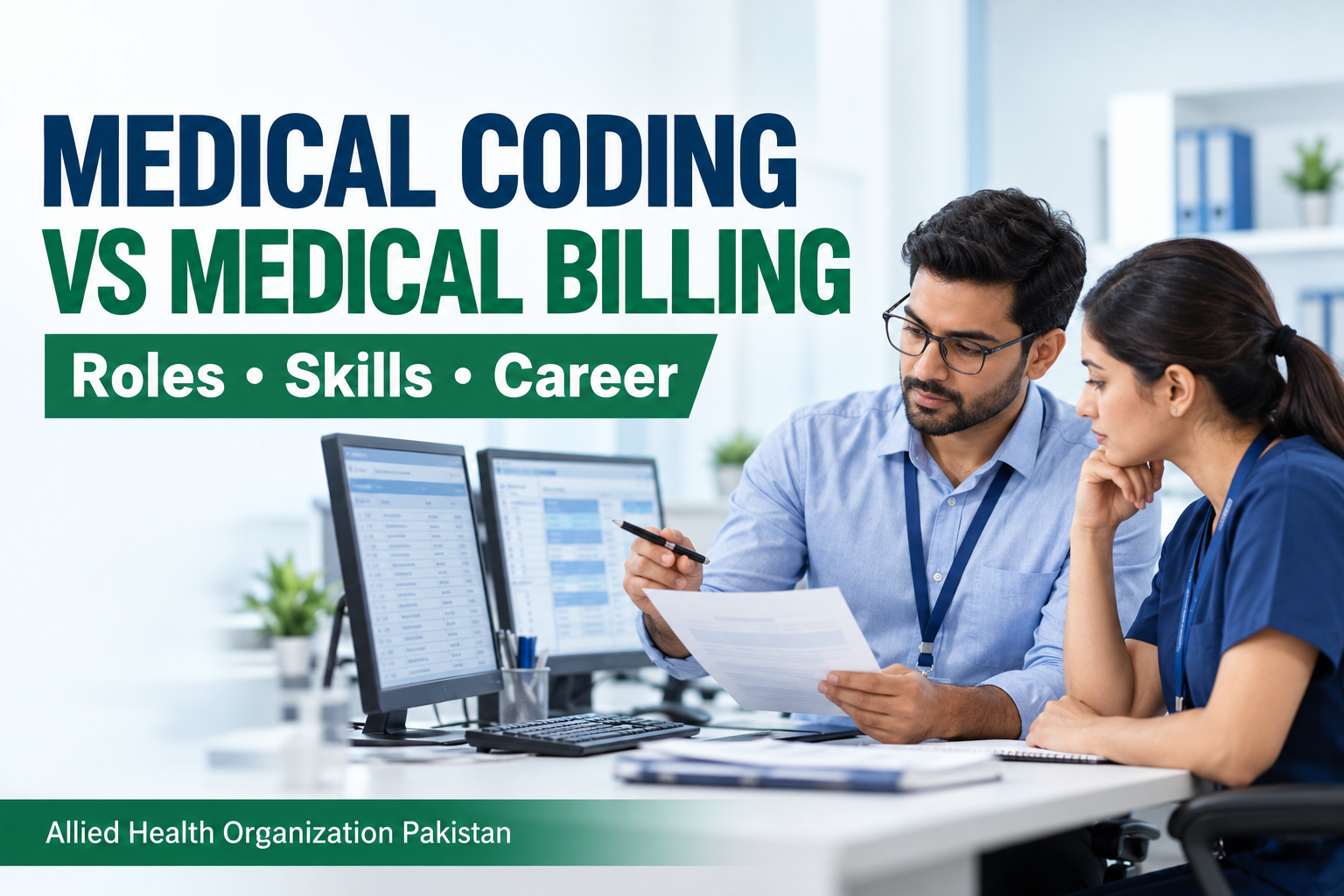
Medical coding vs medical billing is an important distinction for allied health graduates considering a nonclinical career. The two functions interact, but they solve different problems. Coding translates documented services and diagnoses into the appropriate classification system. Billing handles the financial claim and payment workflow. A healthcare qualification can provide useful vocabulary, but it does not automatically establish competence in either job.
What is the difference between medical coding and medical billing?
Medical coding applies relevant classification codes to documented healthcare services under applicable rules. Medical billing manages claim preparation, payer follow-up and payment administration. Some employers combine these tasks. Both need accuracy, confidentiality and suitable training. A clinical degree alone does not provide coding certification or guarantee remote work.
Understand the workflow first
In a simplified insurance workflow, a clinical encounter produces documentation. Coding work applies relevant codes according to the records and applicable rules. Billing work may involve preparing claims, checking payer responses, resolving administrative issues and tracking payments. Real organizations divide these responsibilities differently, so read the job description rather than relying only on the title.
A coder should not invent a diagnosis to make a claim pay. A biller should not change clinical facts to solve a denial. Questions about incomplete documentation belong in an appropriate clarification process. Accuracy and integrity are central to both roles. This guide is career education, not instructions for coding a particular medical case.
Which strengths fit each role?
Coding may suit someone who enjoys detailed rules, medical terminology and careful record review. Billing may suit someone who enjoys organized follow-up, communication, workflow management and problem-solving. Both require accuracy and confidentiality. Neither is simply copying text into software or memorizing a short list of codes.
Try a small learning exercise before buying a long course. Review an authorized fictional example of the workflow and identify which tasks interest you. Do you prefer interpreting documentation within a coding framework, or tracking a claim through submission and follow-up? Use approved training materials rather than real patient files from a workplace.
What an allied health background contributes
Knowledge of anatomy, terminology and clinical processes can help you understand records. However, coding guidelines, payer rules and billing systems need separate training. Do not assume that being a clinician makes you a qualified coder. Likewise, administrative experience does not authorize clinical interpretation outside the documentation.
Write a skills map with two columns: knowledge you already have and skills you still need. Include written English, spreadsheets, secure computer use, documentation review and professional communication. This makes training choices more precise. A course should close a defined gap rather than promise instant remote income.
Evaluate training and credentials
Identify the target market and employer expectations first. The United States, Gulf countries and Pakistan may use different systems and employment requirements. Ask a training provider which credential or practical capability the course prepares you for. Check recognition with the credentialing organization or employer, not only the provider’s advertisement.
Request a syllabus, assessment method, instructor background and realistic practice materials. Ask what support is available after the course and which costs are additional. Avoid guarantees of employment, fixed earnings or effortless freelance work. A certificate is useful only when it represents learning relevant to the role.
Software access and remote work
Employers or clients commonly define the software and access process for their workflow. Do not buy a random billing platform before understanding the job. Ask what training, permissions, security controls and support are provided. Use individual authorized accounts and the agreed communication channels.
Remote work requires a secure environment and clear handling rules for health information. Do not download patient records to personal devices or public AI tools without explicit organizational authorization and appropriate safeguards. Ask how incidents are reported, how access is removed and how quality is checked. These are practical operating questions, not optional extras.
Build an entry-level portfolio responsibly
Use fictional or authorized de-identified exercises to demonstrate organization and reasoning. You could show a sample workflow map, a claim-status tracker with invented data or a summary of how you learned an official rule. Label practice material clearly. Never present simulated work as real client experience.
When applying, state the exact training completed and the tasks you can perform. Describe your clinical background as supporting knowledge. If you need supervised production experience, say so. An honest junior profile is more credible than claiming full revenue-cycle expertise after a short course.
Questions before accepting a job
- Which market, specialties and software does the role cover?
- Is the work coding, billing, payment posting, follow-up or a combination?
- Who provides training and checks quality?
- What are the working hours and communication expectations?
- How is sensitive information protected?
Ask how performance is measured. Speed alone is not a complete measure of quality. Understand how errors are reviewed and corrected. For contract work, clarify scope, payment terms and access responsibilities in writing before beginning.
Frequently asked questions
Can an allied health graduate enter this field?
Potentially, with the relevant additional skills and employer requirements. A clinical degree is not automatic coding certification.
Are coding and billing the same job?
No, although some employers combine tasks. Read the duties carefully.
Do I need to purchase software first?
Not before you understand the employer or client’s system and authorized access arrangements.
Plan the transition
Research actual entry-level vacancies, compare their criteria and choose training accordingly. Keep your professional background accurate. Our allied health roles guide can help you explain transferable knowledge, while our career guide offers context for other pathways. Test your interest with structured learning before making a major career change.
Plan a small learning project
Use a fictional clinic to map an encounter from appointment through documentation, claim preparation, response and follow-up. Label which role handles each stage and where a query must return to the clinician or supervisor. This exercise helps you see the whole process before specializing. It should contain no real patient information.
Next, create a simple tracker with invented cases. Record a status, next action, responsible person and review date. Check whether another person can understand the workflow without a long explanation. This demonstrates organization, which is useful across many administrative roles, without pretending that the exercise is production experience.
Finally, compare the project with a real job description. Identify what remains missing, such as knowledge of a specific coding system or supervised software experience. Use that gap list to choose your next training step. A focused plan is more realistic than buying several unrelated certificates at once.
Sources and further reading
US Bureau of Labor Statistics: healthcare and records career context. International role descriptions are context, not evidence that overseas qualifications or scope apply automatically in Pakistan. Verify current local requirements before enrolling or applying.

You may also like