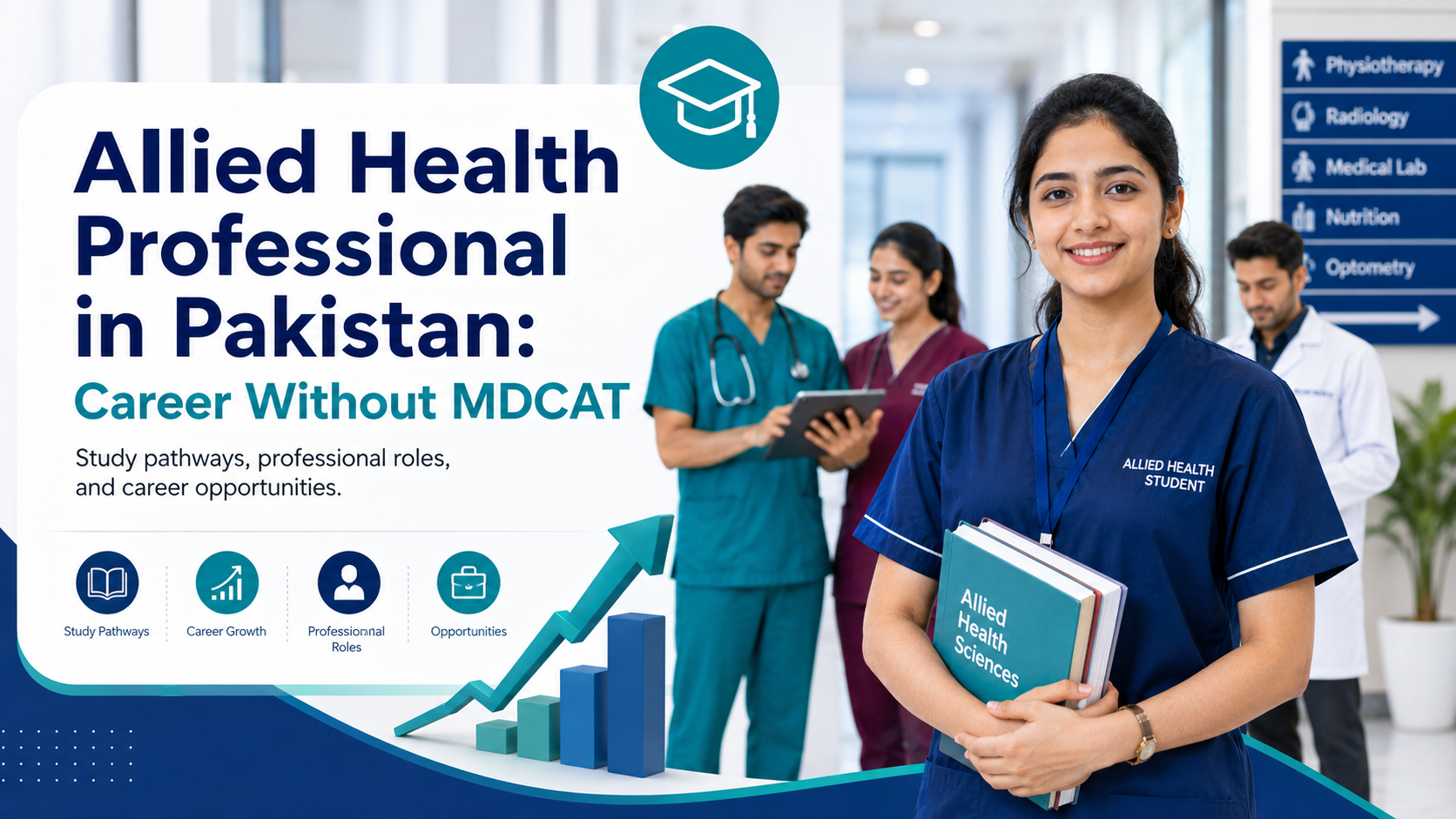
Allied Health Professional in Pakistan: Career Without MDCAT
Every year, thousands of F.Sc Pre-Medical students in Pakistan search for an Allied Health Professional in Pakistan career path—yet most end up preparing for the grueling MDCAT exam, chasing only the dream of becoming a doctor. Consequently, for many, this dream leads to disappointment, anxiety, and burnout. In a country where parents often push their children toward MBBS or engineering, therefore it’s time to explore new, practical alternatives.
What if you could still become an Allied Health Professional—respected, professional, and financially secure—without MDCAT, years of stress, or limited job options?
Welcome to the world of Allied Health Professionals in Pakistan—a rising force in the modern healthcare system.
The Harsh Reality of MBBS in Pakistan
Indeed, while the dream of becoming a doctor remains noble, the path has unfortunately become increasingly unrealistic for many:
- Limited MBBS seats across medical colleges
- High competition in MDCAT
- Expensive tuition and hostel costs
- Post-MBBS struggle to get FCPS/MCPS specialization
- Low starting salaries (as little as PKR 45,000/month in private setups)
- Uncertain government jobs due to IMF-imposed hiring freezes
As a result, even after years of study, many MBBS graduates remain underemployed or stuck in insecure, daily-wage positions.
A Growing Alternative: Allied Health Professional in Pakistan
However, amid these challenges, Allied Health Sciences programs in Pakistan are offering a refreshing alternative for students and professionals alike.
These Allied Health Professional disciplines include:
- Medical Laboratory Technology
- Radiology & Imaging
- Anesthesia Technology
- Operation Theater Technology
- Dialysis & Cardiology Technology
- Physiotherapy and Speech Therapy
Moreover, offered as BS Hons in Allied Health through top HEC-recognized universities, these programs lead directly to BPS-17 scale jobs, the same grade MBBS graduates begin with.
Why Choose an Allied Health Professional in Pakistan Career?
🔹 1. No MDCAT Required
First of all, most allied health programs do not require an entry test, making it easier and faster to begin your healthcare journey.
🔹 2. Job-Ready in Just 4 Years
Moreover, a BS (Hons) in Allied Health program can be completed in just 4 years. Students can then directly enter the job market or pursue MPhil/PhD for specialization.
🔹 3. Equal Government Recognition
Furthermore, Allied Health Professionals now have legal standing, thanks to the Allied Health Professionals Council (AHPC)—similar to PMDC for doctors.
🔹 4. High Demand in Hospitals & Labs
In addition, with growing hospitals and private clinics across Pakistan, allied health graduates are in demand both in urban and rural areas.
🔹 5. Entrepreneurial Freedom
You can open:
- Diagnostic labs
- Radiology centers
- Rehabilitation clinics
- Pathology services
Best of all, no MBBS degree is required!
What Can an Allied Health Professional in Pakistan Do After BS Hons?
Understandably, students often ask: Is there a future beyond a bachelor’s degree in Allied Health? The answer is YES:
Notably, as an Allied Health Professional, you can pursue specialization much like doctors—through M.Phil, PhD, or licensing under AHPC. In fact, this pathway opens doors to advanced careers in healthcare without the traditional bottlenecks of medical education.
- Phil and Ph.D. programs now available in most major universities
- Teaching jobs in medical colleges and universities
- Specialist certifications via CPD and international affiliations
- AHPC Licensing to open independent clinics or diagnostic centers
Similarly, much like doctors pursue FCPS/MCPS, allied health graduates can specialize and build thriving careers—without the bottlenecks of traditional medical education.
Local Champions Leading the Movement
Importantly, the rising recognition of Allied Health in Pakistan owes much to the tireless efforts of professionals and policymakers. In particular, Mr. Asad Ul Abbas Naqvi, General Secretary of the Allied Health Organization Punjab, has played a critical role. Through continuous lobbying, awareness, and reform work, leaders like him are reshaping Pakistan’s medical ecosystem—giving Allied Health its rightful place.
Job & Business Opportunities for Allied Health Professionals in Pakistan
🎯 Government Sector
- Public hospitals (Mayo, Jinnah, PIMS)
- Rural Health Units (RHUs) and Basic Health Units (BHUs)
- Health departments and public research labs
🎯 Private Sector
- Clinics and diagnostic chains (e.g., Chughtai Lab, Shaukat Khanum)
- Teaching positions at private universities
- Health startups and telemedicine platforms
🎯 Entrepreneurship & Self-Employment
- Open your own diagnostic lab
- Launch a radiology or physiotherapy center
- Run an online health consultation service
Message to Parents: Time to Think Ahead
Therefore, dear parents, if you’re guiding your children through their education choices, it’s time to look beyond MBBS. The healthcare industry is evolving, and Allied Health fields offer career stability, respect, and growth—without the risks and stress of traditional paths.
Altogether, your children can:
- Start earning early
- Build independent businesses
- Attain respected government jobs
- Teach and train the next generation
Top Institutions Offering Allied Health Programs
- University of Health Sciences (UHS), Lahore
- Dow University of Health Sciences, Karachi
- King Edward Medical University, Lahore
- Punjab Medical Faculty (Diploma options)
- NUMS, Shifa, and private sector universities
FAQs
❓ What is the scope of Allied Health Sciences in Pakistan?
The scope of Allied Health Sciences in Pakistan is excellent and growing rapidly. An Allied Health Professional can work in government hospitals at BPS-17 scale, private clinics, diagnostic labs, teaching institutions, and international health organizations. Additionally, entrepreneurship opportunities exist through diagnostic labs and rehabilitation centers.
❓ Is Allied Health equivalent to MBBS?
While not a doctor, an Allied Health Professional now receives BPS-17 government jobs and is licensed under AHPC—offering similar pay and recognition. Furthermore, the career progression through M.Phil and PhD is now fully comparable to medical pathways in Pakistan.
❓ Can I open a diagnostic lab without MBBS?
Yes, absolutely! An Allied Health Professional with proper licensing from AHPC and a relevant BS or M.Phil degree can legally run their own diagnostic lab, radiology center, or rehabilitation clinic. Therefore, this makes allied health a strong entrepreneurial option.
❓ Is there an entry test for Allied Health programs?
In most cases, no. Direct admissions are offered based on F.Sc or diploma qualifications.
❓ Can I pursue M.Phil or PhD after Allied Health?
Certainly. Many public and private universities now offer M.Phil and PhD programs in Allied Health Sciences, making advanced education accessible.
Conclusion: Your Future Doesn’t Need MDCAT
Clearly, the medical world is changing. Pakistan needs more than just doctors—it needs technologists, therapists, diagnosticians, and innovators.
Allied Health Professionals in Pakistan are consequently rising to meet that need. Whether you’re a student, a parent, or a professional looking for a better path, now is the time to act.
🎓 Say goodbye to entrance exam pressure.
💼 No more dead-end careers.
📈 Furthermore, missed opportunities become a thing of the past.
Explore Allied Health Sciences and be the future of healthcare in Pakistan.
Become your own boss, gain the respect you deserve, and build a career that is always in demand.
✅ Want to know more?
Explore the official Allied Health Organization Pakistan website or visit the AHPC resources section for M.Phil, Ph.D., and clinical licensing opportunities.