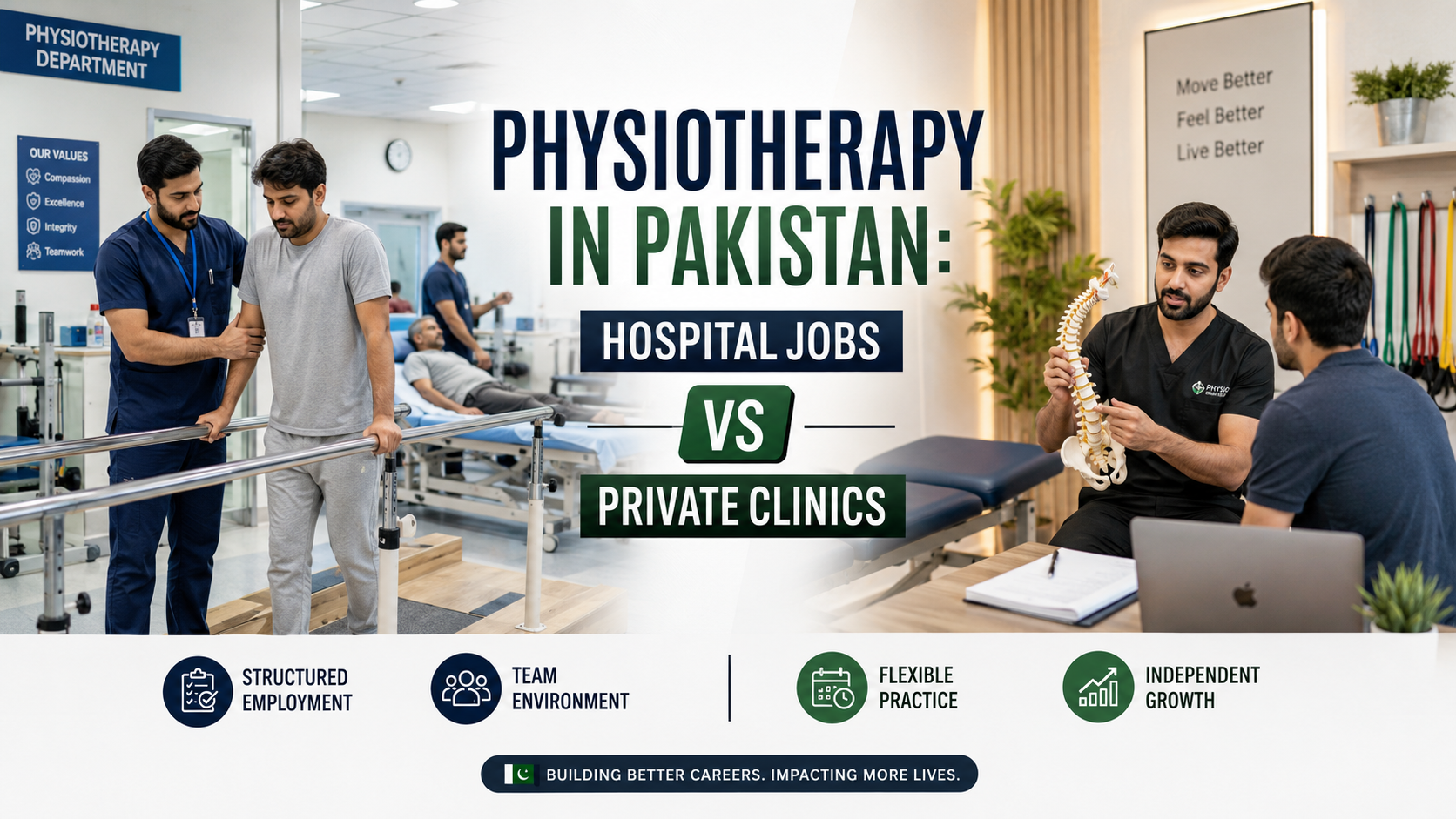
Physiotherapy in Pakistan: Hospital Jobs vs Private Clinics
Physiotherapy in Pakistan is emerging as one of the most promising career paths for Allied Health Professionals in 2025. With increasing demand in both the public and private sectors, physiotherapists are gaining recognition for their critical role in rehabilitation, non-invasive treatment, and patient care. Whether you’re considering a hospital job or thinking about launching your own physiotherapy clinic, understanding both career options is essential. Ultimately, this decision shapes your entire professional future.
This blog will guide you through the benefits, challenges, and must-have skills for each path. If you are an F.Sc (Pre-Medical) student, a diploma holder, or a BS/MS graduate in Allied Health Sciences, this article will help you build a meaningful and future-proof career in Pakistan’s healthcare system. Furthermore, you will gain clarity on which path best suits your personal goals and aspirations.
What Do Allied Health Professionals Do in Pakistan?
Allied Health Professionals (AHPs) work alongside doctors, nurses, and patients in both clinical and non-clinical settings. This group includes physiotherapists, radiographers, lab technologists, paramedics, and more. In addition, AHPs are increasingly recognized under the AHPC Act 2022 as essential members of Pakistan’s healthcare system. Consequently, their demand in both government and private sectors has grown substantially in recent years.
Core Responsibilities of AHPs:
Skilled in diagnosis, rehabilitation, and patient care.
Community-based preventive services are delivered regularly.
Patient education on mobility and recovery is a core function.
✅ Important: As per the Allied Health Professionals Council (AHPC) Act 2022, all AHPs in Pakistan must be registered and licensed. Therefore, obtaining and renewing your license is a non-negotiable step in your professional journey.
Physiotherapy in Pakistan: Government & Private Hospital Jobs
1. Hospital-Based Physiotherapy Jobs (Govt. & Private)
Pros:
Hospital roles provide stable income along with benefits like pension and health insurance.
Furthermore, such positions facilitate collaboration with multidisciplinary teams.
Structured work hours (e.g., 8 am–2 pm) are another key advantage.
As a result, professionals gain access to CPD and HEC-approved training opportunities.
Cons:
Career growth is limited due to fixed government pay scales.
Moreover, promotions are usually slow and highly competitive.
Entrepreneurial expansion is rarely possible in such roles.
Examples of Employers:
DHQ/THQ hospitals, teaching hospitals
Rehab and orthopedic centers


2. Private Physiotherapy Practice in Pakistan – A Career Path for Growth ✅
Pros:
Private practice enables independence and schedule flexibility.
As a result, income potential can be significantly higher than in hospitals.
Specialization (e.g., sports, geriatrics, neuro rehab) becomes more accessible.
Furthermore, deeper patient engagement and satisfaction are achievable.
Cons:
Starting a clinic requires investment in space, equipment, and branding.
Consequently, income may fluctuate considerably in the early stages.
Business skills, legal compliance, and licensing knowledge are also essential.
Common Practice Models:
Home-based therapy
In-clinic care (often with GPs/dentists)
Online consultations via telehealth platforms
Skills Needed for a Career in Physiotherapy in Pakistan ✅
To succeed in physiotherapy, professionals need a well-rounded skill set. Both technical expertise and interpersonal abilities are essential for effective patient care. Moreover, staying updated with the latest rehabilitation techniques is critical in today’s evolving healthcare landscape. Therefore, continuous learning must be an ongoing priority.
✅ Technical Competencies:
Manual therapy and rehabilitation techniques
Use of electrotherapy and ultrasound devices
Surgical aftercare planning and support
Accurate clinical record keeping
✅ Soft Skills:
Strong communication and counseling abilities
Ethical conduct and genuine empathy toward patients
Business operations knowledge (especially for clinic owners)
Digital fluency including LMS and telehealth platforms
🎯 To stay competitive, join LMS-based training and CPD programs.
🔗 [LMS CPD Courses for AHPs – Enroll Now]

Future Scope of Physiotherapy and Allied Health Careers in Pakistan ✅
The demand for physiotherapy is rising steadily due to chronic disease, orthopedic injuries, and growing awareness about non-invasive treatments. Indeed, this growth is expected to continue well into the next decade. As a result, now is the ideal time to build your physiotherapy career in Pakistan. In fact, experts predict that Allied Health will become one of the fastest-growing sectors nationally.
Emerging Trends Include:
Expansion of AHPC registration and anti-quackery enforcement
Growth of specialized clinics in cities like Gujranwala, Lahore, and Karachi
Additionally, AI-powered tools are revolutionizing rehabilitation care
Stronger recognition for AHPs as distinct professionals from doctors
Doctors vs Paramedics in Pakistan: Know the Difference
Understanding the difference between doctors and paramedics is important for career planning. However, many students confuse the two roles. Therefore, the table below clearly outlines the key distinctions to help you make an informed decision.
| Aspect | Doctors | AHPs / Paramedics |
|---|---|---|
| Education | MBBS, BDS | F.Sc, Diploma, BS Allied |
| Role | Diagnose & treat | Assist, rehabilitate, support |
| Workplace | Hospitals, Clinics | Clinics, labs, OTs, rehab centers |
| Regulatory Body | PMDC | AHPC |
💡 Keep in mind, AHPs now have clear licensing, fair pay scales, and official job classifications across Pakistan. Therefore, their professional status has never been stronger.
How to Start a Physiotherapy Career in Pakistan (Step-by-Step Guide) ✅
Step 1: Academic Route
F.Sc (Pre-Medical) → BS (Hons) Physiotherapy (5 years)
Alternatively, Diploma → Bridge Semester → ADP or BS (Hons)
Step 2: Complete CPD Requirements
Attend workshops and online LMS modules on a regular basis
Additionally, ensure CPD hours consistently meet AHPC requirements
Step 3: Get Licensed
Apply to AHPC and maintain a valid license at all times
Moreover, renew it every 3–5 years as legally required
Opportunities for Physiotherapists in Gujranwala & Other Cities
Pakistan’s second-tier cities are rapidly developing their healthcare infrastructure. Consequently, physiotherapists who are willing to work outside major metros are finding excellent opportunities. For instance, cities like Gujranwala, Faisalabad, and Rawalpindi now host established rehabilitation centers. In addition, several universities in these cities offer Bridge Semesters and CPD certifications for upskilling.
Physiotherapy clinics in Gujranwala, Faisalabad, and Rawalpindi offer space-sharing for new graduates.
Many local institutions also offer Bridge Semesters and CPD certifications for upskilling.
Therefore, these regions are ideal for starting a private or partnered physiotherapy practice.
🔗 [Apply Now for BS Allied Health – Gujranwala Campus]
🔗 [CPD Programs – Allied Health Organization Pakistan]
FAQs – Physiotherapy Jobs and Licensing in Pakistan ✅
Q1. What is the average salary of physiotherapists in 2025 Pakistan?
New graduates typically earn between PKR 40,000–80,000 in hospitals. Meanwhile, private practices can exceed that figure significantly, depending on clientele and location.
Q2. Can I open a private physiotherapy clinic legally?
Yes—provided you are licensed by AHPC and follow clinical and municipal laws. In addition, you must ensure your premises meet local health authority standards.
Q3. What distinguishes allied health from nursing?
Nursing focuses on bedside and drug care, whereas allied health includes diagnostics, therapies, and rehabilitation. Both roles, however, are essential in modern healthcare delivery.
Q4. How can diploma holders switch to BS Allied Health?
Through a Bridge (Zero) Semester followed by direct admission into BS (Hons). This pathway, therefore, makes higher education accessible to working professionals.
Q5. Is AHPC registration necessary?
Absolutely. It’s mandatory under the AHPC Act 2022 for legal practice. Consequently, practicing without registration can lead to serious legal consequences.
Conclusion: Physiotherapy in Pakistan is Growing – Are You Ready? ✅
In conclusion, whether you prefer structured hospital employment or flexible private practice, success in physiotherapy depends on your commitment to learning, licensing, and patient-centered care. Moreover, those who invest in continuous professional development will consistently stay ahead of the competition. Indeed, the future belongs to physiotherapists who combine clinical excellence with business acumen.
Allied Health is becoming a cornerstone of healthcare in Pakistan. Therefore, now is the perfect time to act and secure your future. In fact, the opportunities have never been more promising for qualified physiotherapists across Pakistan.
👉 Enroll in CPD courses, apply for licensing, and take the next step in your physiotherapy career today!