
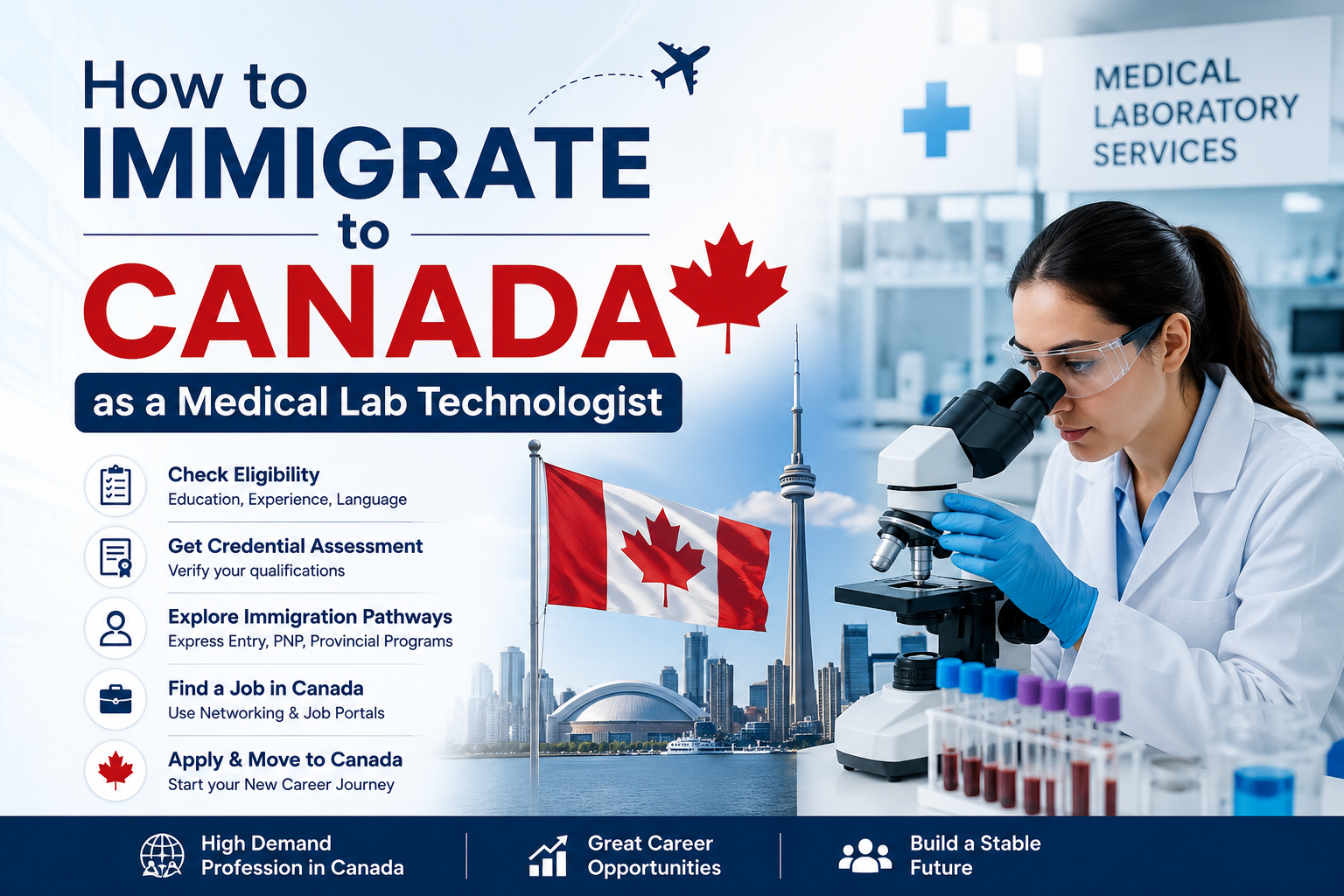
How to Immigrate to Canada as a Medical Lab Technologist
Do you want to immigrate to Canada as a medical lab technologist? You are making a smart move. Canada urgently needs qualified MLTs. In fact, the country faces a serious healthcare workforce shortage. Therefore, medical laboratory technologists are in high demand across all provinces.
This step-by-step guide covers everything you need to know. Specifically, we explain credential recognition, immigration pathways, language requirements, job searching, and what to expect after arrival. By the end, you will have a clear action plan to start your Canadian journey.
What Is a Medical Laboratory Technologist?
A medical laboratory technologist (MLT) is a healthcare professional who performs diagnostic tests on blood, tissue, and other body fluids. These tests help doctors detect diseases, monitor health conditions, and guide treatment decisions. In Canada, therefore, MLTs work in hospitals, clinics, public health labs, and research centres.
The National Occupational Classification (NOC) code for MLTs in Canada is 32120. This is a regulated profession. Consequently, you must register with a provincial regulatory body before you can work legally as an MLT in Canada.
Why Canada Needs Medical Laboratory Technologists
Canada’s healthcare system is under significant strain. First, the population is aging rapidly. As a result, the demand for diagnostic testing has risen sharply. Meanwhile, many experienced MLTs are retiring. This gap between supply and demand has created strong immigration opportunities for qualified professionals.
Here is why Canada actively recruits international MLTs:
- Over 40% of Canada’s MLT workforce is nearing retirement age
- Rural and remote communities face critical laboratory shortages
- IRCC has introduced dedicated healthcare draws under Express Entry
- Several provinces have targeted MLT recruitment programs
- Canadian hospitals actively recruit internationally trained MLTs
If you are a qualified MLT from Pakistan, India, the Philippines, or any other country, Canada’s immigration system actively supports your pathway. You can explore our medical laboratory technology resources to strengthen your credentials before applying.
Step 1 — Understand Canadian Credential Recognition
Credential recognition is your most important first step. Canada does not automatically accept foreign MLT qualifications. Therefore, you must have your credentials assessed and verified before you can register to practise.
The Canadian Society for Medical Laboratory Science (CSMLS)
The CSMLS is the national professional body for MLTs in Canada. It assesses international credentials through its Equivalency Assessment (EA) process. This assessment determines whether your education and training meet Canadian standards.
Here is what the CSMLS credential assessment process involves:
- Submit your transcripts, course outlines, and proof of work experience to CSMLS
- CSMLS then reviews your documents against Canadian MLT education standards
- Next, you receive an assessment report identifying any gaps in your training
- If gaps exist, you may need bridging programs or additional coursework
- Finally, once approved, you are eligible to write the CSMLS national certification exam
Passing the CSMLS exam is required for provincial registration in most provinces. Therefore, start this process early — it can take 3 to 6 months. Our team at Allied Health Organization Pakistan can help you prepare your documentation for international credential assessments.
Step 2 — Choose Your Immigration Pathway
Canada offers several immigration pathways for medical laboratory technologists. The right pathway depends on your qualifications, language scores, and whether you have a job offer. Let us look at the main options.
Express Entry — Federal Skilled Worker Program
Express Entry is Canada’s main immigration system for skilled workers. The Federal Skilled Worker (FSW) program is the most commonly used stream for internationally trained MLTs. To qualify, you need:
- At least one year of skilled work experience (NOC 32120)
- A valid Educational Credential Assessment (ECA)
- Language test scores meeting IRCC minimums (IELTS or CELPIP for English)
- Sufficient points under the Comprehensive Ranking System (CRS)
Additionally, IRCC has introduced dedicated healthcare occupation draws targeting NOC codes in healthcare, including 32120. As a result, CRS cut-off scores in healthcare draws are often lower than general draws. This gives MLTs a real advantage. According to Immigration, Refugees and Citizenship Canada (IRCC), Express Entry draws for healthcare workers have been increasingly frequent since 2023.
Provincial Nominee Programs (PNPs)
If your Express Entry CRS score is not high enough, Provincial Nominee Programs (PNPs) offer an excellent alternative. In fact, several provinces actively nominate MLTs because of local shortages.
Key provinces with strong MLT demand include:
- Alberta: Alberta Advantage Immigration Program (AAIP) targets healthcare workers
- British Columbia: BC PNP Health Authority stream for internationally trained lab professionals
- Saskatchewan: Saskatchewan Immigrant Nominee Program (SINP) for in-demand healthcare occupations
- Manitoba: Manitoba Provincial Nominee Program (MPNP) for skilled healthcare workers
- New Brunswick and Nova Scotia: Atlantic provinces with active healthcare recruitment
Importantly, a provincial nomination adds 600 CRS points to your Express Entry profile. This virtually guarantees an Invitation to Apply (ITA) for permanent residence.
Temporary Foreign Worker Program (TFWP)
Some MLTs enter Canada on a temporary work permit first. A Canadian employer obtains a Labour Market Impact Assessment (LMIA) and sponsors your work permit. However, this route is slower. Nevertheless, it can be effective if you already have a job offer from a Canadian employer.
Step 3 — Meet the Language Requirements
Strong English language skills are essential to immigrate to Canada as a medical lab technologist. Canadian labs use English for all documentation, reporting, and communication. Furthermore, language test scores are a key factor in your CRS score.
Accepted language tests for Express Entry include:
- IELTS Academic or General Training: Minimum CLB 7 in all four bands
- CELPIP General: Minimum CLB 7 in all four bands
- TEF Canada or TCF Canada: Required if applying to Quebec
Higher language scores significantly boost your CRS points. Therefore, aim for CLB 9 or above for a competitive profile. Additionally, CSMLS requires proof of English proficiency for internationally trained applicants. Check our IELTS preparation resources to help you achieve your target score.
Step 4 — Complete Your Educational Credential Assessment (ECA)
An Educational Credential Assessment (ECA) verifies that your foreign degree is equivalent to a Canadian qualification. For immigration purposes, you need an ECA from an IRCC-designated organization.
For MLTs, the recommended ECA providers include:
- World Education Services (WES): The most widely used ECA provider in Canada
- International Credential Evaluation Service (ICES): Accepted in British Columbia
- Comparative Education Service (CES): University of Toronto’s evaluation service
Note that the CSMLS Equivalency Assessment is separate from the immigration ECA. Consequently, you may need both. The CSMLS assessment is for professional registration. In contrast, the WES or ICES assessment is for your immigration application.
Step 5 — Find a Job in Canada
A Canadian job offer is not mandatory for Express Entry. However, it adds significant CRS points and strengthens your application. Moreover, some PNP streams require a job offer.
Where to Find MLT Jobs in Canada
These are the best platforms to find medical laboratory technologist jobs in Canada:
- CSMLS Job Board: Dedicated job board for Canadian laboratory professionals
- HealthForceOntario: Ontario’s healthcare recruitment portal with active MLT listings
- Alberta Health Services: Posts lab vacancies regularly with an international recruitment section
- BC Health Careers: British Columbia’s official health sector job board
- Indeed Canada and LinkedIn: Filter specifically for MLT or medical laboratory technologist roles
- Direct hospital applications: Large hospital networks like Vancouver General and Toronto General Hospital have international recruitment processes
When applying from abroad, be honest about your timeline. Many Canadian employers are experienced in hiring internationally trained MLTs. Therefore, a conditional offer letter — stating employment pending completion of credential recognition — is a common and accepted arrangement.
Step 6 — Register With Your Provincial Regulatory Body
After arriving in Canada, you must register with the regulatory body in your province. Registration is required before you can legally practise as an MLT. Moreover, each province has its own regulatory body.
Here are the main provincial regulatory bodies for MLTs:
- Alberta College of Medical Laboratory Technologists (ACMLT) — Alberta
- BC Biomedical Association (BCBCA) — British Columbia
- Medical Laboratory Technologists of Manitoba (MLTM) — Manitoba
- Ontario Society of Medical Technologists (OSMT) — Ontario
- Ordre professionnel des technologistes médicaux du Québec (OPTMQ) — Quebec
Registration typically requires passing the CSMLS national exam. Therefore, you should aim to complete this before or shortly after arriving in Canada. Many employers will also sponsor you during the registration process.
Salary and Working Conditions for MLTs in Canada
Medical laboratory technologists earn competitive salaries in Canada. Compensation varies by province, employer, and experience level. Here are the typical salary ranges:
- Entry-level MLT salary: CAD $55,000 – $65,000 per year
- Mid-level MLT salary: CAD $65,000 – $80,000 per year
- Senior MLT salary: CAD $80,000 – $95,000+ per year
Most Canadian lab positions come with full benefits. These typically include health insurance, dental coverage, pension plans, and paid vacation. Furthermore, public sector positions in hospitals and government labs offer the strongest job security and benefits packages.
According to the World Health Organization (WHO), strong healthcare workforce policies are critical for delivering quality diagnostic services globally. Consequently, Canada’s investment in MLT recruitment directly aligns with WHO’s global health workforce strategy.
Immigration Timeline: What to Expect
The full immigration process takes time. However, with good planning, you can complete it efficiently. Here is a realistic timeline for those who want to immigrate to Canada as a medical lab technologist:
- Months 1–3: Submit CSMLS credential assessment and language test
- Months 3–6: Receive CSMLS assessment results and ECA report
- Months 4–6: Create Express Entry profile and enter the pool
- Months 6–12: Receive Invitation to Apply (ITA) and submit permanent residence application
- Months 12–18: Application processing, medical exams, and police clearances
- Month 18–24: Receive Confirmation of Permanent Residence (COPR) and land in Canada
Some applicants move faster. Others take longer, depending on document preparation and CRS scores. Additionally, PNP nominations can speed up the process considerably. For more guidance, visit the official Government of Canada immigration website.
Key Takeaways
- Canada has a high demand for medical laboratory technologists due to an aging workforce and population
- Express Entry (FSW program) is the most common immigration pathway for qualified MLTs
- Provincial Nominee Programs offer an excellent alternative if your CRS score is low
- CSMLS credential assessment and the CSMLS national exam are required for professional registration
- IELTS or CELPIP with minimum CLB 7 is required for Express Entry
- MLT salaries in Canada range from CAD $55,000 to $95,000+ depending on experience and province
- Start the credential recognition process as early as possible — it takes 3–6 months
Frequently Asked Questions
Can I immigrate to Canada as a medical lab technologist without a job offer?
Yes. A job offer is not required for Express Entry’s Federal Skilled Worker program. However, having a valid Canadian job offer adds 50–200 CRS points to your profile. This significantly improves your chances of receiving an Invitation to Apply (ITA). As a result, many MLTs successfully immigrate without a prior job offer.
How long does it take to immigrate to Canada as an MLT?
The full process typically takes 18 to 24 months. This includes CSMLS credential assessment (3–6 months), language testing, creating your Express Entry profile, waiting for an ITA, and processing your permanent residence application. Therefore, proper planning and document preparation can help speed up the process significantly.
Is the CSMLS exam mandatory to work as an MLT in Canada?
Yes, in most provinces. The CSMLS national certification exam is required for provincial registration. Without provincial registration, you cannot legally practise as an MLT in Canada. However, some provinces allow you to work under supervision while awaiting exam results. Nevertheless, you must pass to maintain your registration.
Which Canadian province is best for medical laboratory technologists?
Alberta and British Columbia are currently the strongest provinces for MLT opportunities. Both provinces face significant healthcare workforce shortages. Moreover, Alberta Health Services actively recruits internationally trained MLTs. Ontario and Saskatchewan also have strong demand. Ultimately, the best province depends on your qualifications and where you prefer to live.
Can I bring my family when I immigrate to Canada as an MLT?
Yes. Canadian permanent residence applications can include your spouse or common-law partner and dependent children. Once you receive permanent residence, your family members have full authorization to work and study in Canada. Therefore, Canada is an excellent destination for families seeking a better quality of life.
What is the salary of a medical laboratory technologist in Canada?
MLT salaries in Canada range from CAD $55,000 to $95,000 per year depending on experience, province, and employer. Entry-level positions typically start around CAD $55,000–$65,000. Furthermore, experienced MLTs in senior roles or specialized areas can earn over CAD $90,000 annually. Public sector positions in hospitals often offer the best total compensation packages.
Do I need French to work as an MLT in Canada?
Outside of Quebec, English is the primary working language in Canadian hospitals and laboratories. In contrast, French is required for immigration and professional registration in Quebec. If you are applying to other provinces, strong English skills (IELTS or CELPIP) are sufficient. However, bilingualism can be an advantage in some federal and community health roles.
Start Your Canadian Journey Today
Immigrating to Canada as a medical lab technologist is a realistic and achievable goal. Canada needs your skills. Furthermore, the immigration system supports healthcare workers. The quality of life in Canada is consistently ranked among the best in the world.
The key is to start early. Therefore, begin your CSMLS credential assessment today. Take your IELTS exam. Research provincial programs that match your profile. Additionally, take each step with confidence — thousands of internationally trained MLTs have successfully made this journey.
Are you ready to take the next step in your healthcare career? Join Allied Health Professionals Membership to boost your career. Our membership gives you access to career guidance, credential support, professional development resources, and a network of allied health professionals across Pakistan and beyond.
You can also explore our allied health courses and check our certification programs to strengthen your qualifications before applying to Canada. Our team is here to support your international career goals every step of the way.