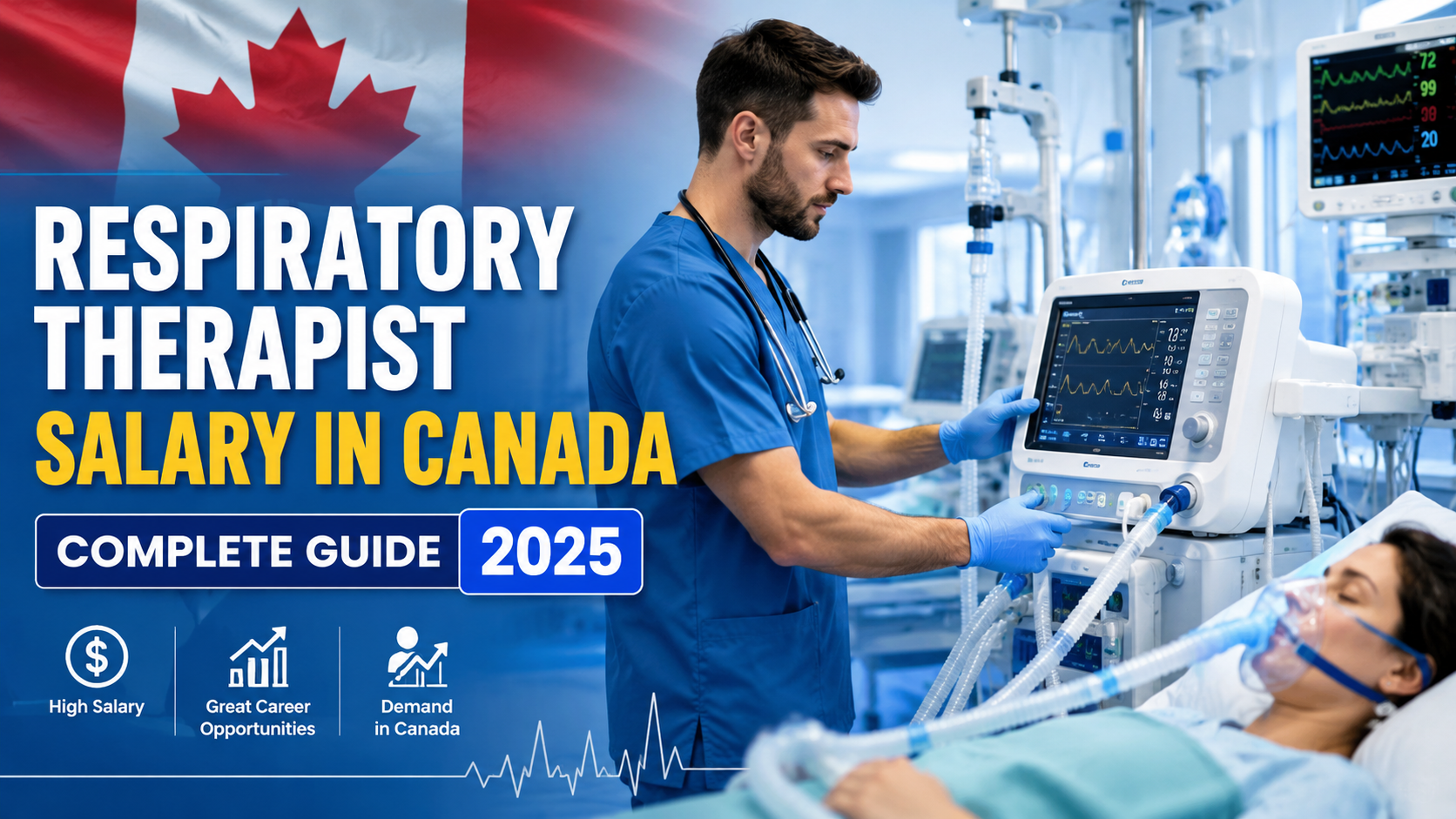
Respiratory Therapist Salary in Canada: Complete Guide 2025
Respiratory therapist salary in Canada ranges from CAD $55,000 to CAD $95,000 per year, depending on province, experience, and workplace setting. If you are a Pakistani healthcare professional planning to work in Canada, or a Canadian student choosing a career path, this guide gives you everything you need to know in simple, clear language.
Canada faces a growing shortage of respiratory therapists. According to Employment and Social Development Canada, demand for respiratory therapists is expected to remain strong through 2030. This makes it one of the most stable allied health careers in the country.
What Is a Respiratory Therapist?
A respiratory therapist (RT) is a certified healthcare professional who evaluates, treats, and manages patients with breathing or cardiopulmonary disorders. They work with patients suffering from asthma, chronic obstructive pulmonary disease (COPD), pneumonia, COVID-19 complications, and other lung conditions.
In Canada, respiratory therapists are regulated healthcare professionals. They work in hospitals, clinics, long-term care facilities, and home care settings. Their role has become even more important after the COVID-19 pandemic highlighted the critical need for respiratory care specialists.
Respiratory Therapist Salary in Canada: Quick Answer
If you want a quick answer for the featured snippet: The average respiratory therapist salary in Canada is approximately CAD $72,000 per year, which equals about CAD $35 per hour. Entry-level RTs earn around CAD $55,000/year, while experienced therapists in senior roles can earn over CAD $95,000/year.
Respiratory Therapist Salary by Province in Canada (2025)
Salaries vary significantly across provinces. Here is a detailed comparison of respiratory therapist salaries across major Canadian provinces:
| Province | Average Annual Salary (CAD) | Hourly Rate (CAD) | Demand Level |
|---|---|---|---|
| Ontario | $68,000 – $88,000 | $33 – $42 | Very High |
| British Columbia | $70,000 – $92,000 | $34 – $44 | High |
| Alberta | $72,000 – $95,000 | $35 – $46 | Very High |
| Quebec | $60,000 – $80,000 | $29 – $38 | Moderate |
| Manitoba | $62,000 – $82,000 | $30 – $39 | Moderate |
| Saskatchewan | $65,000 – $85,000 | $31 – $41 | Moderate |
| Nova Scotia | $58,000 – $78,000 | $28 – $37 | Moderate |
| New Brunswick | $57,000 – $76,000 | $27 – $36 | Low-Moderate |
Source: Job Bank Canada (Government of Canada), 2025 estimates.
Respiratory Therapist Salary by Experience Level
Experience plays a major role in determining how much a respiratory therapist earns in Canada. The table below breaks down salary expectations at different career stages:
| Experience Level | Annual Salary (CAD) | Typical Role |
|---|---|---|
| Entry Level (0–2 years) | $55,000 – $65,000 | Staff RT, Hospital |
| Mid-Level (3–5 years) | $65,000 – $80,000 | Senior RT, ICU Specialist |
| Experienced (6–10 years) | $80,000 – $90,000 | Lead RT, Clinical Educator |
| Senior (10+ years) | $90,000 – $100,000+ | Supervisor, Manager, Consultant |
Respiratory Therapist Salary vs. Other Allied Health Professionals in Canada
How does the respiratory therapist salary compare with other allied health careers in Canada? Here is an honest comparison to help you make an informed decision:
| Healthcare Profession | Average Annual Salary (CAD) | Demand Level |
|---|---|---|
| Respiratory Therapist | $72,000 | Very High |
| Registered Nurse (RN) | $85,000 | Very High |
| Medical Lab Technologist | $68,000 | High |
| Physiotherapist | $78,000 | High |
| Radiological Technologist | $73,000 | High |
| Occupational Therapist | $80,000 | High |
| Pharmacist | $110,000 | Moderate |
Respiratory therapists earn a competitive salary compared to most allied health professions. The career also offers job security, shift flexibility, and strong immigration pathways for internationally trained professionals — especially those from Pakistan.
How to Become a Respiratory Therapist in Canada
To work as a respiratory therapist in Canada, you need to follow a clear educational and licensing pathway. Here are the key steps:
Step 1: Complete an Accredited RT Program
You must complete a 2–3 year diploma or degree program from a Canadian Accreditation Council-approved institution. Programs are offered at colleges in Ontario, BC, Alberta, and other provinces. Courses include anatomy, physiology, pharmacology, and clinical practice.
Step 2: Pass the National Board Exam
After completing your program, you must pass the Canadian Board for Respiratory Care (CBRC) national certification exam. This exam tests your clinical knowledge and practical skills. Passing this exam qualifies you as a Registered Respiratory Therapist (RRT).
Step 3: Register with Your Provincial College
Each province has its own regulatory body. For example, in Ontario it is the College of Respiratory Therapists of Ontario (CRTO). In BC, it is the British Columbia College of Allied Health Professionals (BCCAHP). You must register and maintain your license to practice legally.
Step 4: Apply for Jobs
You can find respiratory therapist jobs on Indeed Canada, the Government of Canada Job Bank, and hospital career portals. Most hospitals in Ontario and Alberta actively recruit RTs, including internationally educated professionals.
Respiratory Therapist Salary in Canada for Pakistani Professionals
Pakistan has a large pool of trained healthcare professionals, including respiratory therapists and pulmonary function technicians. If you are a Pakistani allied health professional looking to immigrate to Canada and work as an RT, there is a clear path available to you.
The average salary in Pakistani Rupees (PKR) converted from CAD $72,000 is approximately PKR 2.5 to 2.8 Crore per year (based on 2025 exchange rates). This is many times higher than local salaries for similar roles in Pakistan, making Canada an attractive destination for Pakistani healthcare workers.
Immigration Pathways for Pakistani RTs to Canada
Pakistani respiratory therapists can explore several immigration routes to Canada, including:
- Express Entry (Federal Skilled Worker Program) – Respiratory therapists fall under NOC 32102, which qualifies for Express Entry.
- Provincial Nominee Programs (PNP) – Provinces like Alberta, Ontario, and Manitoba actively nominate healthcare workers.
- Health Authority Job Offers – A direct job offer from a Canadian hospital significantly boosts your immigration score.
- Bridging Programs – Some Canadian colleges offer bridging programs to help internationally educated RTs get Canadian credentials faster.
The Government of Canada’s Express Entry program is one of the fastest and most transparent ways to get permanent residency. You can also check WHO’s health workforce guidelines for international healthcare worker mobility standards.
For more information on how Pakistani allied health professionals can move to Canada, read our detailed guide on how to immigrate to Canada as a medical lab technologist — many of the same steps apply to RTs.
Top Cities for Respiratory Therapists in Canada
Location matters. The city where you work as an RT can significantly affect your salary and quality of life. Here are the top cities to work as a respiratory therapist in Canada:
| City | Average Salary (CAD/year) | Cost of Living | Job Market |
|---|---|---|---|
| Calgary, AB | $85,000 – $95,000 | Moderate-High | Excellent |
| Edmonton, AB | $80,000 – $92,000 | Moderate | Very Good |
| Toronto, ON | $72,000 – $88,000 | Very High | Excellent |
| Vancouver, BC | $74,000 – $90,000 | Very High | Very Good |
| Winnipeg, MB | $68,000 – $82,000 | Low-Moderate | Good |
| Ottawa, ON | $70,000 – $85,000 | Moderate | Good |
Calgary and Edmonton in Alberta consistently offer the highest salaries for respiratory therapists in Canada. They also have a lower tax burden compared to Ontario and BC, which means more take-home pay.
Benefits and Perks of Working as a Respiratory Therapist in Canada
Beyond the base salary, Canadian RTs enjoy a strong benefits package. Most hospital and public sector positions include:
- Extended health and dental coverage for the employee and family
- Pension plan (especially in government and hospital roles)
- Paid vacation — typically 3–4 weeks per year
- Shift differentials for evening, night, and weekend work
- Continuing education allowance to support professional development
- Sick leave and maternity/paternity benefits under Canada’s Employment Insurance (EI)
These benefits can add an estimated CAD $15,000–$25,000 in total compensation value on top of the base salary.
EEAT Note: Why Trust This Guide?
This guide is written by the editorial team at Allied Health Organization Pakistan (AHO-PK), a professional body dedicated to supporting Pakistani allied health professionals in navigating international career opportunities. Our content is based on data from the Government of Canada Job Bank, the Canadian Institute for Health Information (CIHI), and real-world salary surveys from healthcare recruitment agencies operating in Canada.
We update our salary data annually to ensure accuracy. If you find outdated information, please contact us so we can review and revise accordingly.
Frequently Asked Questions (FAQ)
What is the average respiratory therapist salary in Canada per year?
The average respiratory therapist salary in Canada is approximately CAD $72,000 per year. Salaries range from CAD $55,000 for entry-level positions to over CAD $95,000 for senior and supervisory roles, depending on the province and experience level.
Which province pays the highest salary for respiratory therapists in Canada?
Alberta offers the highest respiratory therapist salaries in Canada, with average annual pay ranging from CAD $72,000 to $95,000. Calgary and Edmonton are the top cities for RTs in Alberta, with strong job demand from both public hospitals and private clinics.
Can a respiratory therapist from Pakistan work in Canada?
Yes. Pakistani respiratory therapists or pulmonary function technicians can work in Canada by having their credentials assessed, completing any required bridging education, and passing the CBRC national certification exam. The NOC code for respiratory therapists in Canada is 32102, which is eligible for Express Entry immigration.
How many hours does a respiratory therapist work per week in Canada?
Most respiratory therapists in Canada work 37.5 to 40 hours per week in full-time hospital positions. Shift rotations are common, including day, evening, and overnight shifts. Part-time and casual positions are also widely available.
Is respiratory therapy a good career in Canada in 2025?
Yes, absolutely. Respiratory therapy is one of the most in-demand allied health careers in Canada. The aging Canadian population, rising rates of COPD and asthma, and ongoing effects of the COVID-19 pandemic have all increased the demand for skilled RTs. Job security is high, salaries are competitive, and immigration pathways are well-established for internationally trained professionals.
What is the NOC code for respiratory therapist in Canada?
The National Occupation Classification (NOC) code for respiratory therapists in Canada is 32102 under the 2021 NOC system. This classification includes cardiology technologists and electrophysiological diagnostic technologists as well.
How long does it take to become a respiratory therapist in Canada?
It typically takes 2 to 3 years to complete a respiratory therapy diploma or degree program at a Canadian college or university. After graduation, you must pass the CBRC national exam and register with your provincial regulatory college before you can practice.
Final Thoughts: Is Respiratory Therapy Worth It in Canada?
Yes — respiratory therapy is a rewarding, well-paid, and stable career in Canada. Whether you are a fresh Canadian graduate or an experienced Pakistani healthcare professional looking to build a new life in Canada, respiratory therapy offers excellent earning potential, strong job security, and a clear immigration pathway.
With average salaries ranging from CAD $55,000 to $95,000+ per year, comprehensive benefits packages, and one of the strongest job outlooks in Canadian healthcare, choosing respiratory therapy as a career is a smart decision in 2025 and beyond.
If you are a Pakistani allied health professional planning to immigrate to Canada, explore our other guides on working in Canada as an allied health professional and the step-by-step immigration process for healthcare workers.
Disclaimer: Salary figures mentioned in this article are based on publicly available data from the Government of Canada Job Bank, Indeed Canada, and allied health salary surveys. Actual salaries may vary based on employer, qualifications, and market conditions. This content is for informational purposes only and should not be taken as financial or immigration advice.