
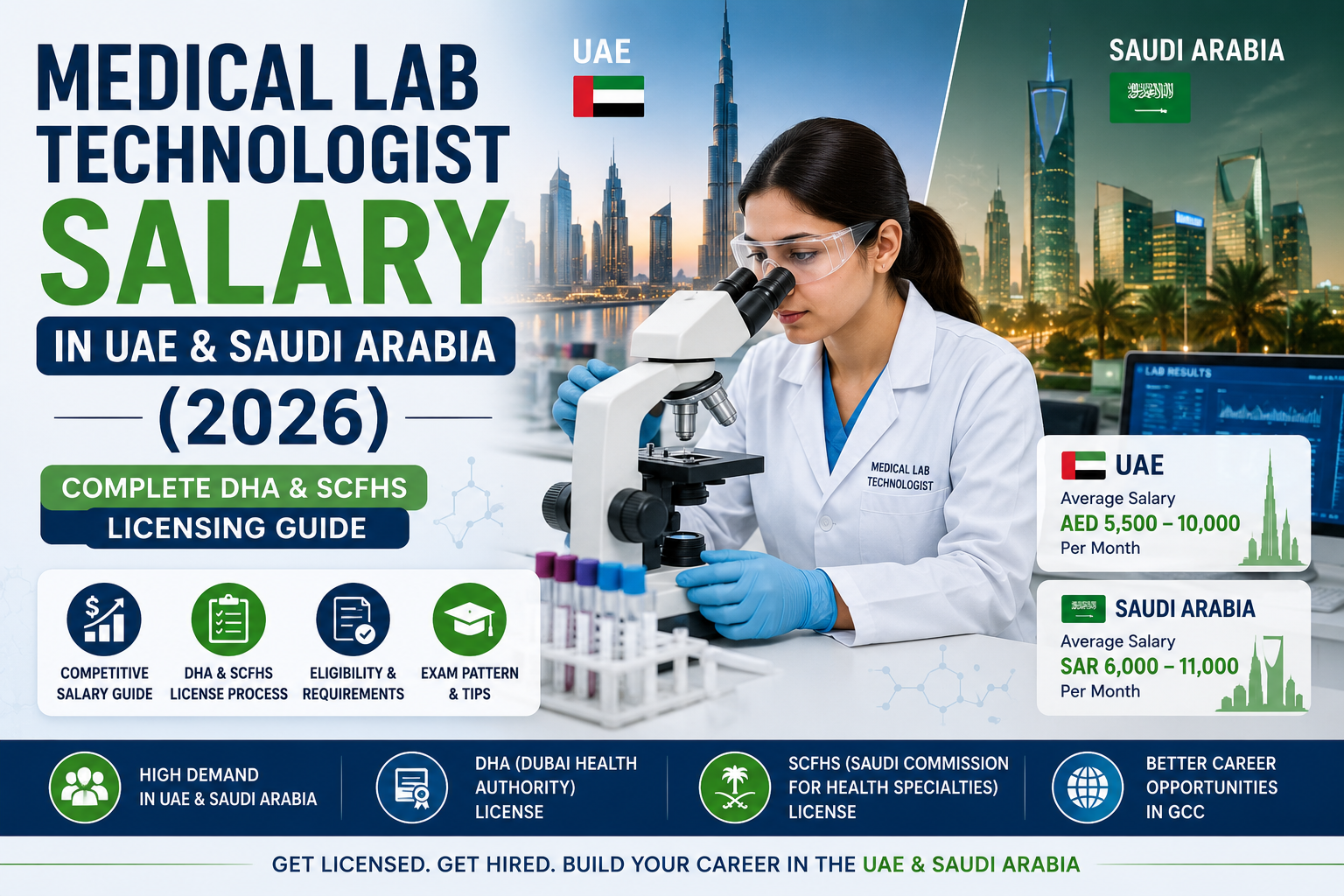
Medical Lab Technologist Salary in UAE & Saudi Arabia (2026): Complete DHA & SCFHS Licensing Guide
Every second message we get from allied health professionals in Pakistan about medical lab technologist salary in UAE and Saudi Arabia asks some version of the same question: “Bhai, Dubai ya Saudi mein MLT ki job kitni paisay ki hai, aur license kaise banta hai?” The honest answer is more nuanced than any single number. That nuance is exactly what determines whether your Gulf move pays off or leaves you frustrated three months into a contract you didn’t fully understand.
This guide breaks down the medical lab technologist salary in UAE and Saudi Arabia — what you actually earn, why the same job title can pay wildly different amounts depending on one word in your job offer, and the exact licensing steps — DHA in Dubai, SCFHS in Saudi Arabia — you need to complete before you ever board a flight.
Quick answer: UAE lab technicians typically earn AED 3,000–5,000/month, while bachelor’s-level technologists with DHA or SCFHS Specialist classification report AED 7,000–15,000+/month. Saudi Arabia packages are often tax-free with housing and flight allowances added on top. Your classification tier — not your job title — is what actually determines your salary ceiling.
Why Gulf Healthcare Systems Are Recruiting Pakistani Lab Professionals
Both the UAE and Saudi Arabia are in the middle of long-term healthcare expansion programs. Saudi Arabia’s Vision 2030 is driving major investment in new hospitals and diagnostic infrastructure. The Kingdom continues to rely on internationally trained laboratory staff for specialized roles in molecular biology, blood banking, and clinical chemistry, even as Saudization pushes more routine positions toward local graduates. The UAE’s private hospital and diagnostic lab sector has grown just as fast, particularly in Dubai and Abu Dhabi, creating steady demand for licensed lab technologists and technicians from South Asia.
Pakistani MLTs hold a strong position here. Local training already covers hematology, microbiology, clinical chemistry, and blood banking — the same core domains tested in Gulf licensing exams. What most candidates get wrong isn’t their lab skills. It’s the paperwork sequence, and the assumption that “technician” and “technologist” are interchangeable job titles. They are not, and confusing the two costs candidates real money.
The Medical Lab Technologist Salary Question in UAE & Saudi Arabia: Why “It Depends” Is the Correct Answer
Search for “MLT salary Dubai” and you’ll find numbers ranging from under AED 1,000 a month to over AED 15,000 a month for what looks like the same job. That spread isn’t inconsistent data. It reflects four separate variables stacked on top of each other, and understanding them is worth more than any single figure we could give you.
What Determines Your Salary
1. Technician vs. Technologist classification. This is the single biggest swing factor. Diploma holders classified as lab technicians sit at the lower end of the pay scale. They often earn in the range of AED 3,000 to AED 5,000 per month in the UAE for entry-level roles. Bachelor’s-degree holders classified as medical technologists, especially those with a DHA or SCFHS “Specialist” classification, routinely report packages in the AED 7,000 to AED 15,000+ per month range once you include allowances. Same lab, same bench, very different title, very different paycheck.
2. Employer type. Government and semi-government hospitals (in both the UAE and Saudi Arabia) typically pay more and offer stronger benefits than small private diagnostic centers. They’re also more competitive to enter, though, and usually prioritize candidates with prior Gulf experience or a stronger classification.
3. Country and city. Dubai and Abu Dhabi generally out-pay other Emirates for lab roles. In Saudi Arabia, specialized centers like tertiary referral hospitals pay meaningfully more than routine MOH facility postings, particularly for molecular diagnostics, histopathology, and blood bank technology.
4. Allowances that don’t show up in the base number. Saudi packages commonly include a housing allowance (roughly SAR 2,000–5,000 a month, or shared employer accommodation), annual return flights, 21–30 days of paid leave, and end-of-service gratuity. A base salary quoted without these add-ons understates total compensation. Always ask for the full package breakdown, not just the basic salary line, before comparing offers.
The Bottom Line on Classification and Medical Lab Technologist Salary
The takeaway: don’t chase a number you saw in a Facebook group. Chase the classification. Get your credentials evaluated for Technologist/Specialist status wherever your qualification supports it, because that single classification decision will define your salary ceiling for years.
| Factor | Lower End | Higher End |
|---|---|---|
| Classification | Technician (diploma) | Technologist/Specialist (bachelor’s) |
| Employer type | Small private diagnostic center | Government/semi-government hospital |
| Location | Smaller city/routine posting | Dubai/Abu Dhabi, tertiary referral center |
| Package | Base salary only | Base + housing + flights + gratuity |
Getting Licensed in Dubai: The DHA Pathway
The Dubai Health Authority (DHA) license is mandatory for anyone practicing as a lab technician or technologist in Dubai’s hospitals, labs, or diagnostic centers. Here’s the sequence, start to finish.
The DHA Licensing Steps
Step 1 — Confirm eligibility. You’ll need a diploma or bachelor’s degree in Medical Laboratory Technology, or a recognized equivalent, plus post-qualification experience. DHA generally expects at least two years of hands-on lab experience for diploma holders. Check the current Professional Qualification Requirement (PQR) on DHA’s own portal before you invest in anything else, since DHA periodically revises exact experience thresholds.
Step 2 — Primary Source Verification (PSV) through DataFlow. This confirms your degree and experience letters directly with the issuing institutions. Budget real time for this step — it’s consistently the slowest part of the process, and rushing it by submitting incomplete documents only adds weeks.
Step 3 — Book and pass the Prometric exam. The DHA exam for lab technologists is a multiple-choice format covering safety, hematology, microbiology, biochemistry, blood banking, and immunology/serology. DHA sets and periodically changes passing thresholds and exact question counts. Confirm the current figure directly on DHA’s exam page before you schedule — don’t rely on outdated blog posts, including this one, a year from now.
Step 4 — Receive your Eligibility Letter. Passing the exam gets you an eligibility letter, not a working license. This is what you use to apply for jobs.
Step 5 — Employer activates your full license. Once your employer hires you, they submit the activation request, and DHA issues your full practicing license tied to that facility.
Realistically, budget two to three months from the start of DataFlow verification to holding your eligibility letter, assuming no document delays. Total cost across verification and exam fees typically lands in the low thousands of AED. Treat any number you see quoted online as an estimate, and confirm current fees on DHA and DataFlow’s own sites before paying anything to a third party.
Getting Licensed in Saudi Arabia: The SCFHS / Mumaris Plus Pathway
Saudi Arabia’s Commission for Health Specialties (SCFHS) is the single regulatory body for every healthcare profession in the Kingdom, including laboratory sciences. Everything runs through their Mumaris Plus digital platform.
The SCFHS Licensing Steps
Step 1 — Create your Mumaris Plus profile and confirm your classification tier. SCFHS classifies lab professionals largely by qualification level. A two-to-three-year diploma typically qualifies you for Technician classification, while a four-year bachelor’s degree in medical laboratory science opens the door to Specialist classification. That tier carries meaningfully higher earning potential and career mobility into quality assurance, LIS administration, or lab management roles later on.
Step 2 — Complete DataFlow PSV. As with the UAE, this verifies your academic and employment history at the source, and it’s typically the longest single wait in the entire process.
Step 3 — Apply for Professional Classification and pay the associated fee. Once your documents clear review, SCFHS assigns your classification tier.
Step 4 — Sit the Prometric licensing exam appropriate to your classification. The Technician-level exam and the Technologist/Specialist-level exam are not identical. The Specialist exam leans harder into theory, interpretation, and troubleshooting rather than routine procedure. Study for the exam that matches the classification you’re actually applying for, not a generic “lab tech” question bank.
Step 5 — Institutional registration and Iqama. Once you have a signed offer, your Saudi employer registers you through their institutional Mumaris Plus account. Your professional registration then activates alongside your residency permit (Iqama), and only at this point can you legally begin work.
One detail worth knowing before you go in: SCFHS classification approval alone can take a few weeks after document submission, on top of DataFlow timelines. So if you’re targeting a specific contract start date, begin this process well in advance rather than after you’ve already accepted an offer.
The Step Most Candidates Skip: AHPC Registration First
Here’s the part that surprises a lot of candidates. Your AHPC registration in Pakistan isn’t just a local formality. It’s frequently the foundational document that DataFlow and Gulf employers use to verify that you’re a legitimately trained and recognized allied health professional in your home country. Walking into DataFlow verification without a completed AHPC registration on file is one of the most common, and most avoidable, causes of delay we see. Sort this out before you start your Gulf paperwork, not in parallel with it.
Common Mistakes That Cost Candidates Time and Money That Affect Your Medical Lab Technologist Salary
Applying for the wrong classification tier. Candidates with a bachelor’s degree sometimes apply as “Technician” because a friend told them it’s a faster process. It might be faster, but it locks you into a lower salary band that’s genuinely difficult to renegotiate later without restarting the classification process.
Trusting third-party fee quotes over official portals. DHA and SCFHS set exam fees, passing scores, and experience requirements directly, and they do change them. Always cross-check against dha.gov.ae or scfhs.org.sa before paying an agent or consultant anything.
Treating the base salary as the whole offer. In Saudi Arabia especially, housing allowance, flights, and gratuity can add up to a significant percentage of total compensation. Negotiate and compare the full package, not just the headline number.
Starting Gulf paperwork before finishing AHPC registration. As covered above — get your domestic registration in order first.
Frequently Asked Questions About Medical Lab Technologist Salary
Yes, a diploma qualifies you for Technician-level classification in both countries. A bachelor’s degree in medical laboratory science, however, opens the door to Technologist/Specialist classification, which carries a meaningfully higher salary ceiling and more career mobility over time.
Realistically, plan for two to four months covering DataFlow verification, exam scheduling, and results — longer if your documents need corrections. Starting early, and starting with your AHPC registration already complete, is the single biggest thing you can do to compress this timeline.
Yes. You can typically complete both DataFlow verification and Prometric exam booking from outside the country once you have your eligibility number, though you’ll want to confirm current exam center availability directly through Prometric.
No. A DHA license is valid specifically for Dubai. Practicing in Abu Dhabi requires a separate DOH (formerly HAAD) license, and other Emirates fall under MOH licensing — each with its own classification and exam requirements.
No. They share core subject areas, but the Technologist/Specialist exam places significantly more weight on theory, interpretation, and troubleshooting rather than routine bench procedures. Prepare specifically for the exam tied to your intended classification.
Where to Start
If you’re serious about a Gulf posting and improving your medical lab technologist salary in UAE or Saudi Arabia, sequence matters more than speed. Finalize your AHPC registration, get your DataFlow verification moving as early as possible, and be honest with yourself about which classification tier your actual qualification supports. Rushing any one of these steps to save two weeks typically costs candidates months later.
If you haven’t completed your AHPC registration yet, start there. It’s the document every Gulf verification process will eventually ask for, and having it ready before you begin removes the single most common bottleneck in this entire journey.




1 Comment
Sir I am second year student BSMLT how to go foreign country which step I will follow please tell me