
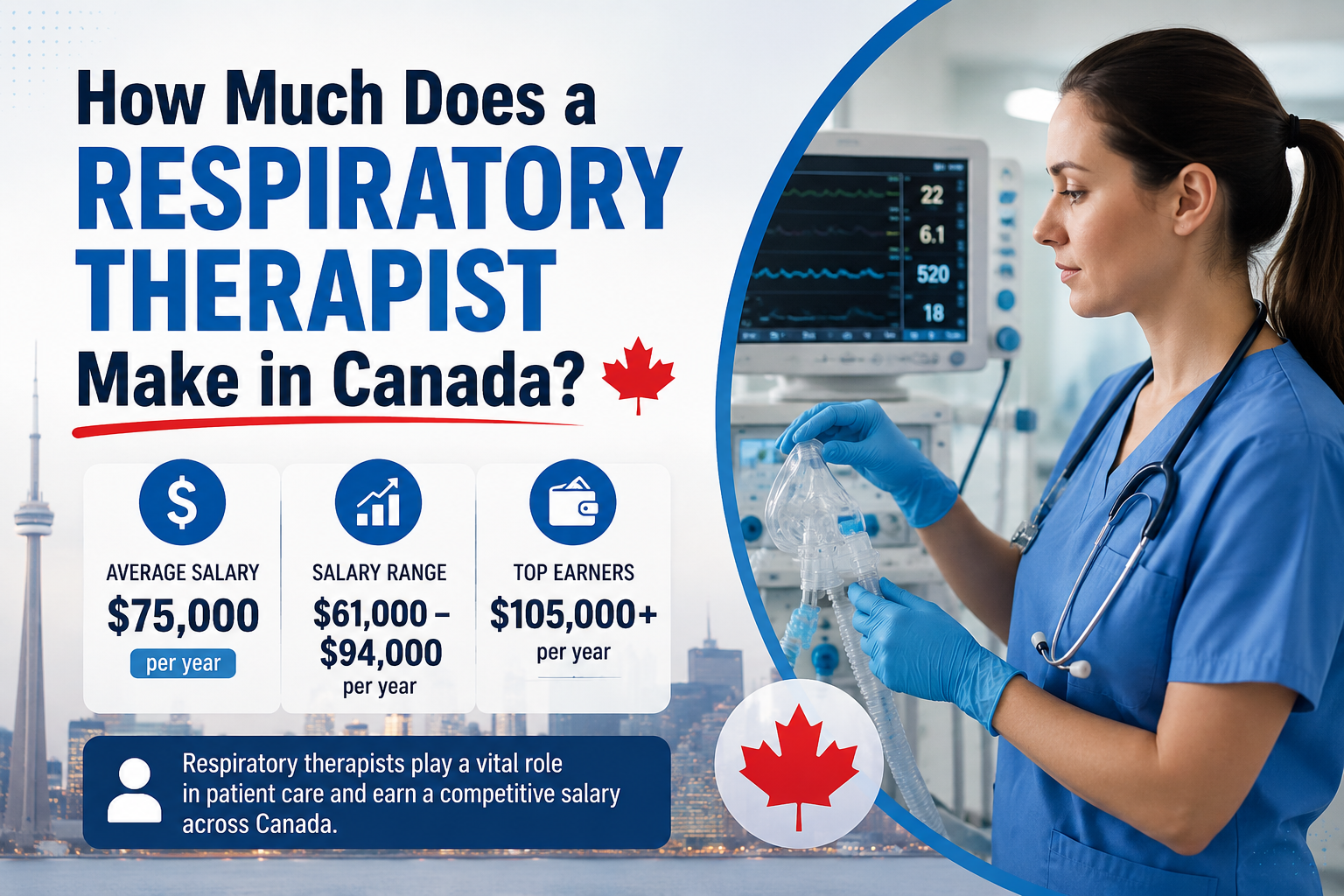
How much does a respiratory therapist make in Canada
- Posted by Nouman Asad - Healthcare Education Consultant
- Categories Blog
- Date June 20, 2026
- Comments 0 comment
Introduction
Respiratory therapy is one of the most critical yet least recognized allied health professions — and understanding respiratory therapist salary in Canada requires knowing what these specialists actually do. These are the clinicians who manage ventilators in ICUs, treat patients during asthma attacks, run pulmonary function tests, and provide newborn resuscitation in delivery rooms. The work is demanding, technically complex, and genuinely life-sustaining.
In Canada, respiratory therapist salary is also surprisingly competitive — particularly when the full picture of public sector benefits, pension contributions, and overtime is factored in. If you are exploring working in Canada as an allied health professional, this guide provides the financial clarity you need.
In this guide, we cover everything you need to know about respiratory therapist salaries in Canada in 2025: provincial breakdowns, factors that affect pay, how to increase your earnings, and what internationally trained RTs need to know about working in Canada.
What Is a Respiratory Therapist?
Specifically, a respiratory therapist (RT) is a regulated healthcare professional who specializes in cardiopulmonary care — the assessment, treatment, and management of patients with conditions affecting breathing and circulation. RTs work in hospitals, long-term care facilities, outpatient clinics, and increasingly in home care settings.
In Canada, regulatory colleges govern the profession in most provinces. The Canadian Society of Respiratory Therapists (CSRT) is the national professional organization, and provincial regulatory colleges oversee licensing. The entry-level qualification is typically a two-year diploma program from an accredited college, though some universities offer degree-completion programs for practicing RTs.
The scope of practice is broad. On any given shift, a hospital-based RT might manage mechanical ventilation for a critically ill ICU patient. They also perform bronchoscopy assistance and run cardiac stress tests. Additionally, they provide aerosolized medication to pediatric patients and conduct polysomnography studies for sleep apnea diagnosis. Few allied health professions carry this degree of clinical responsibility with only a two-year training requirement.
Respiratory Therapist Salary in Canada — National Overview
The average annual salary for a registered respiratory therapist in Canada falls between CAD $70,000 and $90,000, with significant variation by province, employer type, experience level, and specialty area.
For comparison in US dollars, this range currently translates to approximately $52,000 to $67,000 USD — which is lower than comparable US salaries but competitive when Canada’s healthcare system, cost of living in most regions, and total compensation package are considered.
Entry-level RTs — those within the first two years of practice — typically earn between CAD $58,000 and $68,000. After five years of experience, most full-time hospital-based RTs are earning between CAD $75,000 and $88,000. Senior RTs, charge therapists, and those in specialized units such as neonatal intensive care (NICU) or cardiac surgery can earn CAD $90,000 to $105,000 or more when overtime and premium pay are included.
Respiratory Therapist Salary by Province
Provincial variation in RT salaries is more pronounced than in many other allied health professions, partly because collective bargaining agreements differ significantly between provinces and partly because some provinces have acute shortage conditions that push wages upward.
Alberta
Notably, Alberta consistently offers the highest respiratory therapist salaries in Canada. A mid-career RT working for Alberta Health Services earns approximately CAD $85,000 to $100,000 in base salary, with total compensation often exceeding CAD $100,000 when overtime (which is common in AHS hospitals), weekend differentials, and pension contributions are included.
The province faces a persistent shortage of respiratory therapists, particularly in smaller centers and neonatal care. As a result, experienced RTs enjoy significant negotiating leverage. Moreover, steady overtime opportunities are consistently available.
British Columbia
BC salaries for RTs employed by Fraser Health, Vancouver Coastal Health, and other health authorities typically fall in the range of CAD $78,000 to $95,000 for experienced practitioners. Vancouver itself is an expensive city, but the combination of strong salaries, outdoor lifestyle, and mild climate continues to attract respiratory therapists from other provinces and from abroad.
Furthermore, BC has invested in expanding respiratory therapy training capacity following COVID-19, which brought unprecedented attention to the profession’s importance in critical care.
Ontario
Ontario is the largest province and employs the most respiratory therapists in absolute numbers. Salaries in the Toronto area and other major centers typically range from CAD $72,000 to $88,000 for experienced hospital-based RTs. Ontario’s higher cost of living — particularly housing in the Greater Toronto Area — partially offsets what are still solid wages by most standards.
However, smaller Ontario cities and northern communities often offer better value: salaries are comparable or higher (northern allowances exist in some areas), and housing costs are a fraction of Toronto’s.
Quebec
Quebec respiratory therapist salaries are set through provincial collective agreements and typically fall in the range of CAD $60,000 to $80,000. This is lower than Alberta and BC in headline terms. However, Quebec offers generous social programs. These include subsidized childcare at around $10 per day and heavily subsidized post-secondary education. Many RTs value these benefits highly.
Additionally, working in Quebec requires French proficiency both for professional registration and for effective clinical practice in a predominantly French-speaking healthcare environment.
Manitoba and Saskatchewan
The Prairie provinces offer solid mid-range salaries, typically CAD $68,000 to $85,000 for experienced RTs. Both provinces have active recruitment programs for healthcare workers, including respiratory therapists, and offer relocation incentives for qualified applicants willing to work in rural or remote settings.
Atlantic Canada
New Brunswick, Nova Scotia, Prince Edward Island, and Newfoundland and Labrador offer lower base salaries than western provinces — typically CAD $60,000 to $78,000 — but also have significantly lower costs of living. Housing costs in Atlantic cities are dramatically lower than Vancouver or Toronto. Moreover, healthcare workers who have relocated there frequently cite the high quality of life in these regions.
Beyond Base Salary: Total Compensation for Canadian RTs
The raw salary figure understates the value of working as a respiratory therapist in Canada’s public healthcare system. Total compensation typically includes several elements that add significant value:
Shift Premiums and Overtime
Most hospital-based RTs work rotating shifts — days, evenings, and nights, often including weekends and holidays. These shifts carry premium pay:
- Evening shift differential: typically 5 to 10 percent above base hourly rate
- Night shift differential: typically 10 to 15 percent above base
- Weekend differential: varies but commonly 15 to 20 percent above base
- Overtime: typically time-and-a-half or double time depending on collective agreement
For an RT earning CAD $80,000 base salary and working a standard rotating schedule with some overtime, total earnings including premiums can easily reach CAD $95,000 to $110,000.
Pension Benefits
Most hospital-based RTs in Canada participate in defined-benefit pension plans — either provincial healthcare sector plans or HOOPP (Healthcare of Ontario Pension Plan) in Ontario. These plans guarantee a specific monthly retirement income based on years of service and salary. The employer typically contributes 8 to 12 percent of salary to the pension plan. For a mid-career RT, this represents a benefit worth CAD $7,000 to $12,000 per year in addition to base pay.
Extended Health and Dental Benefits
Employer-provided extended health insurance covers prescription drugs, dental care, vision, paramedical services, and often physiotherapy, massage therapy, and mental health supports. For a family, this benefit is worth approximately CAD $5,000 to $10,000 per year.
Annual Leave and Vacation
Most collective agreements provide three to four weeks of annual vacation for new employees, increasing to five or six weeks after ten to fifteen years. Statutory holidays are additional. Compared to many countries where two weeks is standard, this is a meaningful quality-of-life benefit.
How Respiratory Therapist Salaries Compare to Other Allied Health Professions
Within allied health, respiratory therapy offers a strong salary-to-training-length ratio. Consider:
| Allied Health Profession | Avg. Training Length | Avg. Canadian Salary (CAD) |
|---|---|---|
| Respiratory therapist | 2 years diploma | $72,000 – $90,000 |
| Medical lab technologist | 2 years diploma | $68,000 – $85,000 |
| Radiologic technologist | 2–3 years | $65,000 – $82,000 |
| Physiotherapist | 4–6 years degree/master’s | $72,000 – $95,000 |
| Occupational therapist | 4–6 years | $70,000 – $90,000 |
| Paramedic | 2 years | $55,000 – $78,000 |
The two-year training pathway into a career averaging CAD $80,000+ in base salary — with strong benefits and career progression — makes respiratory therapy one of the most financially efficient allied health careers available.
How to Increase Your Salary as a Respiratory Therapist in Canada
1. Specialize in Neonatal or Critical Care
First and foremost, neonatal intensive care respiratory therapy (NICU) is one of the highest-demand and highest-compensating specializations. NICU RTs manage ventilation for premature infants, which requires exceptional technical skill and composure under pressure. Many hospitals pay additional responsibility allowances for NICU-certified staff.
2. Pursue the RRT Designation
Similarly, in provinces that distinguish between basic certification and the Registered Respiratory Therapist (RRT) designation, holding the RRT credential unlocks higher pay grades and access to advanced roles.
3. Move to Alberta or BC
If you are currently practicing in a lower-paying province and have flexibility to relocate, moving to Alberta or British Columbia can add CAD $10,000 to $20,000 to your annual income while maintaining access to an excellent healthcare system and quality of life.
4. Work in a Northern Community
Consequently, northern allowances for healthcare workers in northern Ontario, northern BC, Alberta’s Peace Country region, and the territories can add 15 to 25 percent to base salary. Living in a smaller community is not for everyone, but for those who enjoy outdoor activities and prefer a slower pace, the financial premium is real.
5. Take Leadership Roles
Finally, charge RT positions, clinical educator roles, and department leadership positions all carry pay grades above clinical staff positions. These roles also provide career satisfaction and professional development that pure clinical work may not offer after many years.
Respiratory Therapist Salaries in Canada vs. the United States
The US offers higher absolute salaries for respiratory therapists, and that gap is real.
According to the US Bureau of Labor Statistics, the median annual salary for respiratory therapists in the US is approximately $75,280 USD — with experienced therapists in high-demand states earning $85,000 to $100,000 USD or more. In US dollar terms, that exceeds what most Canadian RTs earn in base salary.
Nevertheless, the comparison is not straightforward:
- US employers do not cover healthcare costs for workers and can represent $15,000 to $25,000 per year in real out-of-pocket expense for a family
- Canadian pension plans are significantly more generous than typical US 401(k) arrangements
- Student debt for US RT programs has risen considerably; Canadian program costs are lower
- Canada’s publicly funded healthcare means zero cost for most medical services personally
Overall, many RTs who have worked in both countries conclude that the quality-of-life and total-compensation comparison is more balanced than the gross salary figures suggest. But for those whose primary goal is maximum take-home pay, the US — particularly states like California, Alaska, or Nevada — does offer higher earnings potential.
Can Internationally Trained Respiratory Therapists Work in Canada?
Yes, and Canada actively recruits internationally trained RTs — but the credential recognition process must be completed before clinical practice.
The Canadian Board for Respiratory Care (CBRC) administers a Prior Learning Assessment (PLA) for internationally trained respiratory therapists. The PLA evaluates your education and clinical training against Canadian standards. Depending on the outcome:
- A full positive assessment means you can write the CBRC certification examination
- A conditional assessment identifies specific gaps that must be addressed through bridging education or supervised practice
The CBRC exam covers all major clinical domains: therapeutics, diagnostics, critical care, neonatal care, and cardiopulmonary physiology.
Moreover, language requirements are also a factor. Canadian immigration requires CLB 7 (roughly IELTS 6.5 overall) for most skilled worker streams, and provincial regulatory bodies typically require equivalent language proficiency for registration.
In total, the entire process — PLA assessment, exam preparation, writing the exam, and provincial registration — typically takes 12 to 24 months. Many internationally trained RTs pursue a Canadian work permit while this process is underway, working in adjacent healthcare roles until full RT registration is achieved.
Frequently Asked Questions
Is respiratory therapy a stable career in Canada? (Explore more allied health career guides on AHOP) Yes. The demand for RTs has grown steadily over the past decade, and COVID-19 significantly increased awareness of — and investment in — the profession. Job security is strong, particularly for those with critical care experience.
Can I work as an RT in Canada with a US certification? A US Registered Respiratory Therapist (RRT) credential from the National Board for Respiratory Care (NBRC) is often recognized through reciprocity arrangements, though provincial registration is still required. The PLA process for US-trained RTs is typically faster than for those trained in other countries.
What cities have the most job opportunities for RTs? Calgary, Edmonton, Vancouver, and Toronto are the largest markets in absolute terms. However, per capita, smaller cities and regional hospitals often have more open positions relative to the available workforce. Northern communities and rural areas frequently have the most acute shortages.
Do respiratory therapists work long shifts? Most hospital-based RTs work 12-hour shifts in Canada — three or four per week. While long, this schedule means more consecutive days off, which many healthcare workers prefer for work-life balance.
How does the RT profession differ from a respiratory nurse? In Canada, respiratory therapy is a distinct regulated profession from nursing. RTs have specialized training specifically in cardiopulmonary care that nurses do not receive in standard nursing programs. In practice, RTs and nurses collaborate closely in ICUs and emergency departments but have distinct scopes of practice.
Final Thoughts
Respiratory therapy in Canada offers a compelling combination: relatively short training, strong salaries with excellent benefits, genuine job security, and work that matters in a very direct and immediate way. The province you choose has a real impact on your earnings, with Alberta and British Columbia consistently at the top.
Furthermore, for internationally trained RTs, Canada is a realistic and welcoming destination — provided the credential recognition process is approached with patience and preparation. The shortage is real, the demand is ongoing, and the profession is increasingly recognized for the critical role it plays in modern healthcare.
Ultimately, whether you are exploring respiratory therapy as a career path, comparing provinces for a potential move, or researching immigration options, the financial picture in Canada is strong enough to take seriously.